How Auto Transport Works
Before you book, take six minutes to understand exactly how auto transport works — from getting your quote to handing over your keys and inspecting your vehicle at delivery. This video was produced by our team and covers the full process in plain language. It’s the same briefing our customer service reps give first-time shippers every day.
What You’ll Learn
- How the auto transport booking process works
- The difference between open and enclosed transport
- What happens at vehicle pickup and what to inspect
- How long shipping takes by distance
- How your vehicle is protected during transit
- What a Bill of Lading is and why it matters
- How to prepare your car for transport
- What happens at delivery and final inspection
What’s Covered in This Video
[00:00] Introduction to Auto Transport
We start with the basics: what auto transport is, who uses it, and why it’s a smarter option than driving your vehicle yourself. You’ll get a clear picture of how the carrier network operates and what to expect from the moment you request a quote.
[00:58] How To Arrange Auto Transport
Booking your move is straightforward. We walk you through how to submit your shipment details, what information you’ll need on hand, and how we match you with a vetted carrier heading your direction.
[01:29] How Do The Pricing Tiers Work?
Auto transport pricing isn’t one-size-fits-all. We explain what drives your quote, including distance, vehicle size, transport type, and seasonal demand, so you know exactly what you’re paying for and when to expect the best rates.
[02:48] Where Can I Ship To or From?
We serve the entire continental United States, door to door. Whether you’re shipping across two states or coast to coast, we cover every zip code. We also explain how proximity to major carrier lanes can affect availability and timing.
[03:06] When Can I Expect Pickup?
We set honest expectations around pickup windows, typically one to three days from your target date, and explain how driver schedules, route logistics, and lead time all factor into when your carrier arrives.
[03:37] How Long Does Shipping Take?
Transit times vary by distance. We break it down clearly: short regional hauls, mid-range interstate moves, and full cross-country shipments, with realistic timeframes for each so you can plan around your schedule.
[03:55] How to Prepare Your Vehicle
Before your carrier arrives, a few simple steps protect you and your car. We cover what to remove, how to document existing condition, fuel level, tire pressure, and anything else that needs to be done the day before pickup.
[04:25] What To Expect At Pickup
This is where the paperwork begins. We walk through the curbside inspection process and the Bill of Lading, the document that legally records your vehicle’s condition before it’s loaded. We explain why it matters and exactly what to check before you sign.
[04:57] What To Expect At Delivery
The final step. We cover how delivery works, what to inspect before signing off, and how to handle situations where a large trailer can’t reach your exact address, like tight residential streets or gated communities, and needs to meet you nearby.
The Auto Transport Process, Step by Step
Step 1: Get a Quote and Book a Carrier
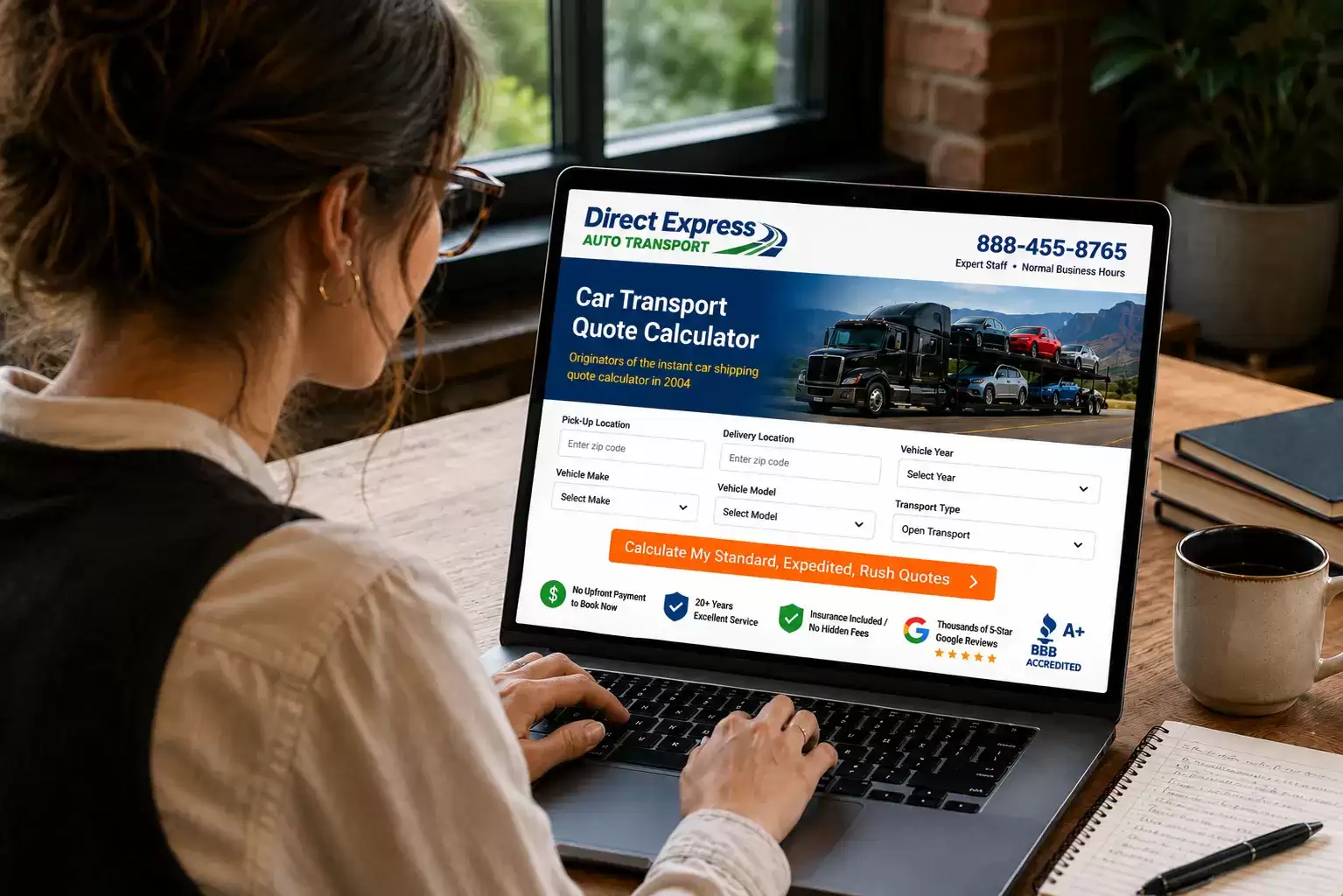
The auto transport process starts when you request a quote. A reputable broker or carrier will ask for your pickup and delivery zip codes, vehicle year, make, and model, your preferred transport type (open or enclosed), and your target pickup date. Most quotes are free and take less than two minutes online.
Once you accept a quote and book, your shipment enters the carrier network. Booking 1 to 2 weeks in advance gives carriers the best opportunity to match you with an available driver heading your direction.
Step 2: Choose Open vs. Enclosed Transport
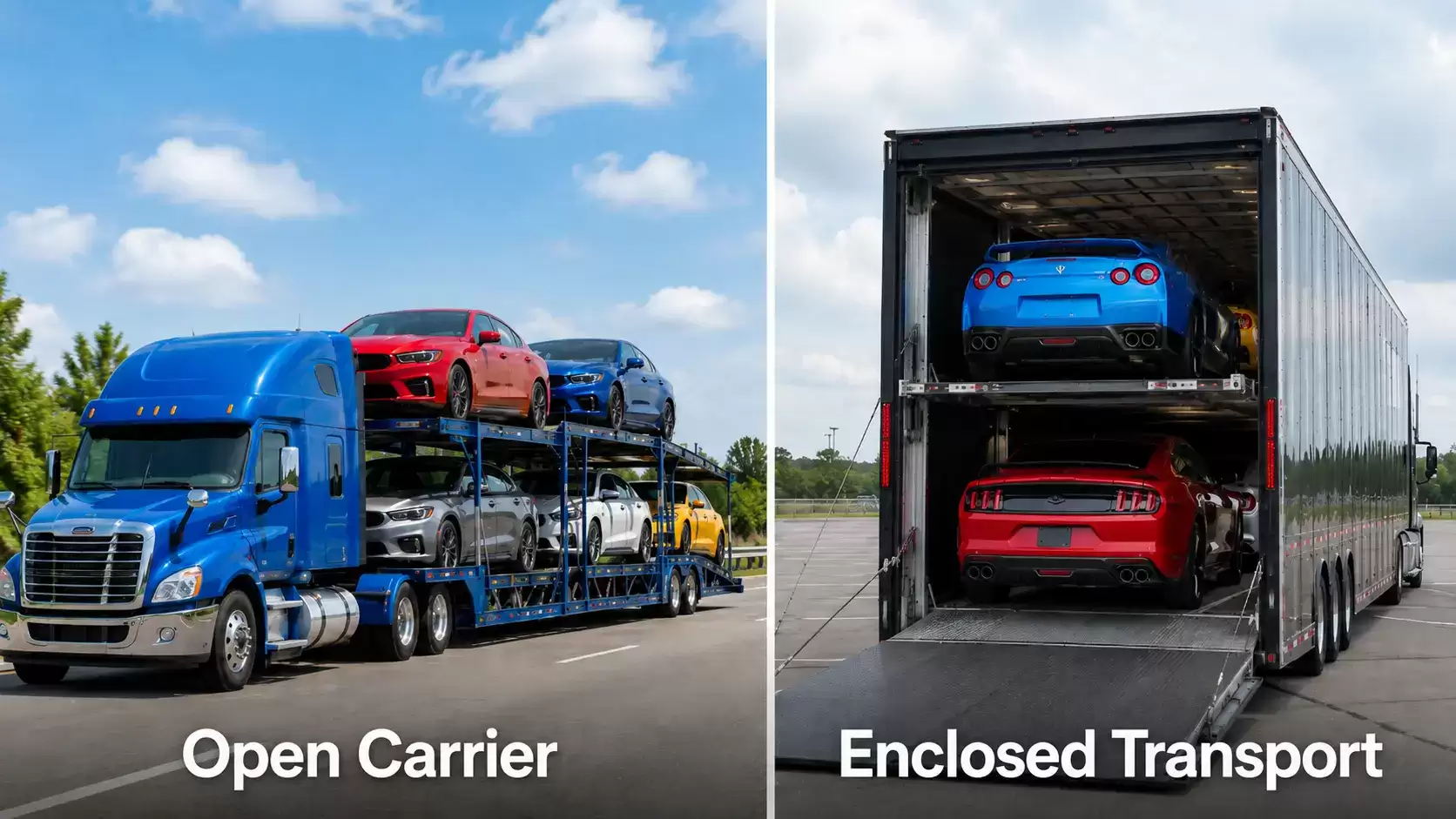
Open transport uses an open air multi car trailer, the industry standard representing roughly 90% of all vehicle shipments. Enclosed transport uses a covered trailer that protects your vehicle from weather and road debris, recommended for luxury, classic, or high value vehicles.
Step 3: Prepare Your Vehicle for Pickup
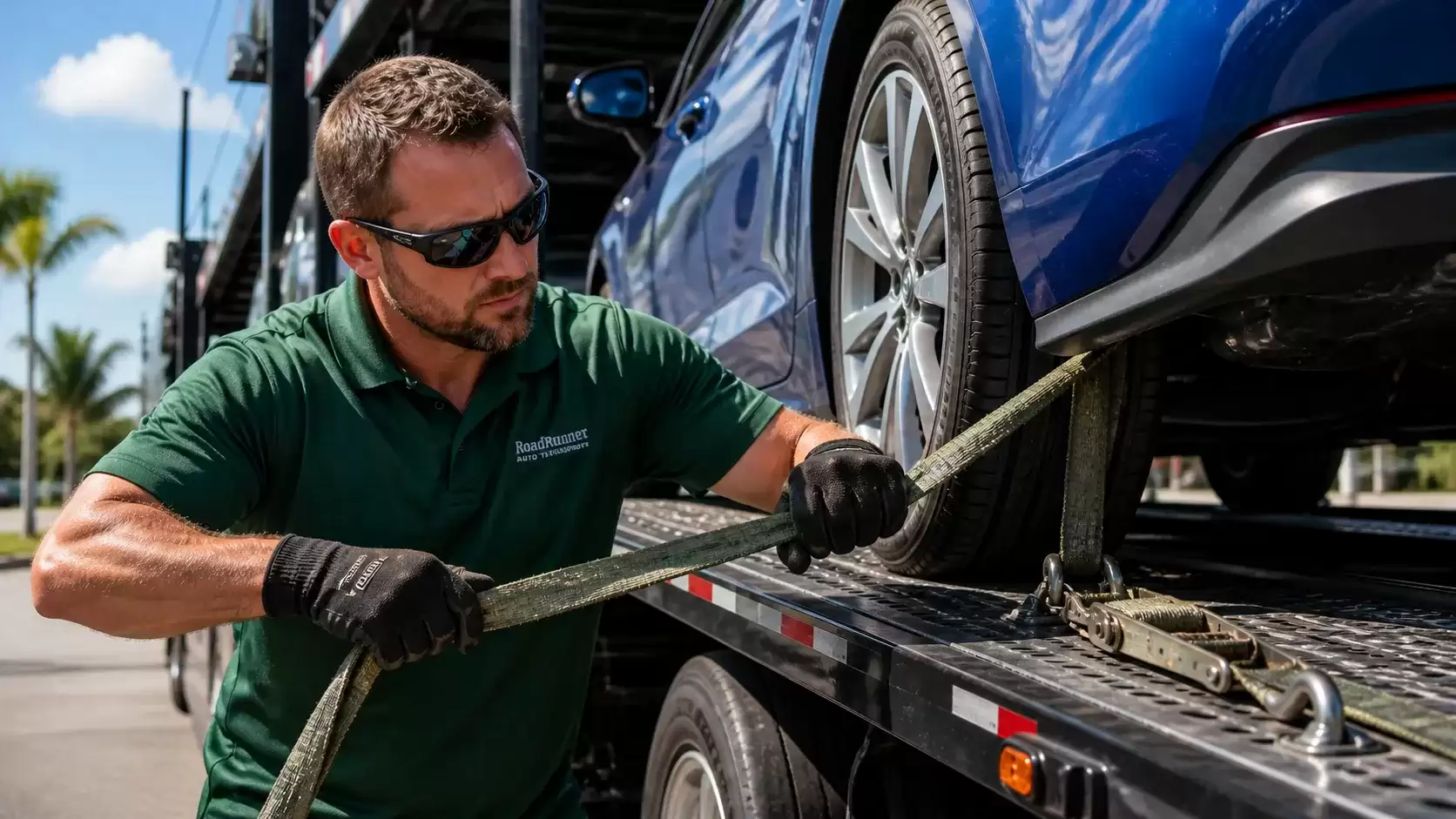
Remove personal belongings. Leave only a quarter tank of gas. Photograph existing damage. Disable toll transponders. Check tire pressure and battery. Retract or remove accessories.
Step 4: Pickup and the Bill of Lading
The driver conducts a joint inspection and documents your vehicle’s condition on the Bill of Lading. You both sign it. Keep your copy, you will compare it at delivery. Never sign a blank or incomplete Bill of Lading.
Step 5: In Transit
Most car transport drivers travel about 500 miles per day. Doing the math: Multiply the number of miles on the route and divide by 500. Then add a day or two for pick ups and drop offs for the entire carrier load. While not an exact science, you should come close to estimating the transit time.
Step 6: Delivery and Final Inspection
Inspect the vehicle thoroughly before signing the delivery Bill of Lading. Compare to your pickup photos. Note any new damage specifically before you sign. Once signed without noting damage, filing a claim becomes very difficult.
Insurance Coverage During Transport
All licensed carriers are federally required to carry cargo insurance. You can request a Certificate of Insurance after carrier assignment.
How Much Does Auto Transport Cost?
Most domestic car shipments fall between $500 and $1,500. Price depends on distance, vehicle size, transport type, and current carrier availability on your route.
How Auto Transport Works – Video Transcript
Introduction
[00:00] We’re Direct Express Auto Transport, and we make it easy for anyone to ship a vehicle. After nearly 20 years in business, we’ve become America’s highest-rated auto shipping broker by offering what others can’t.
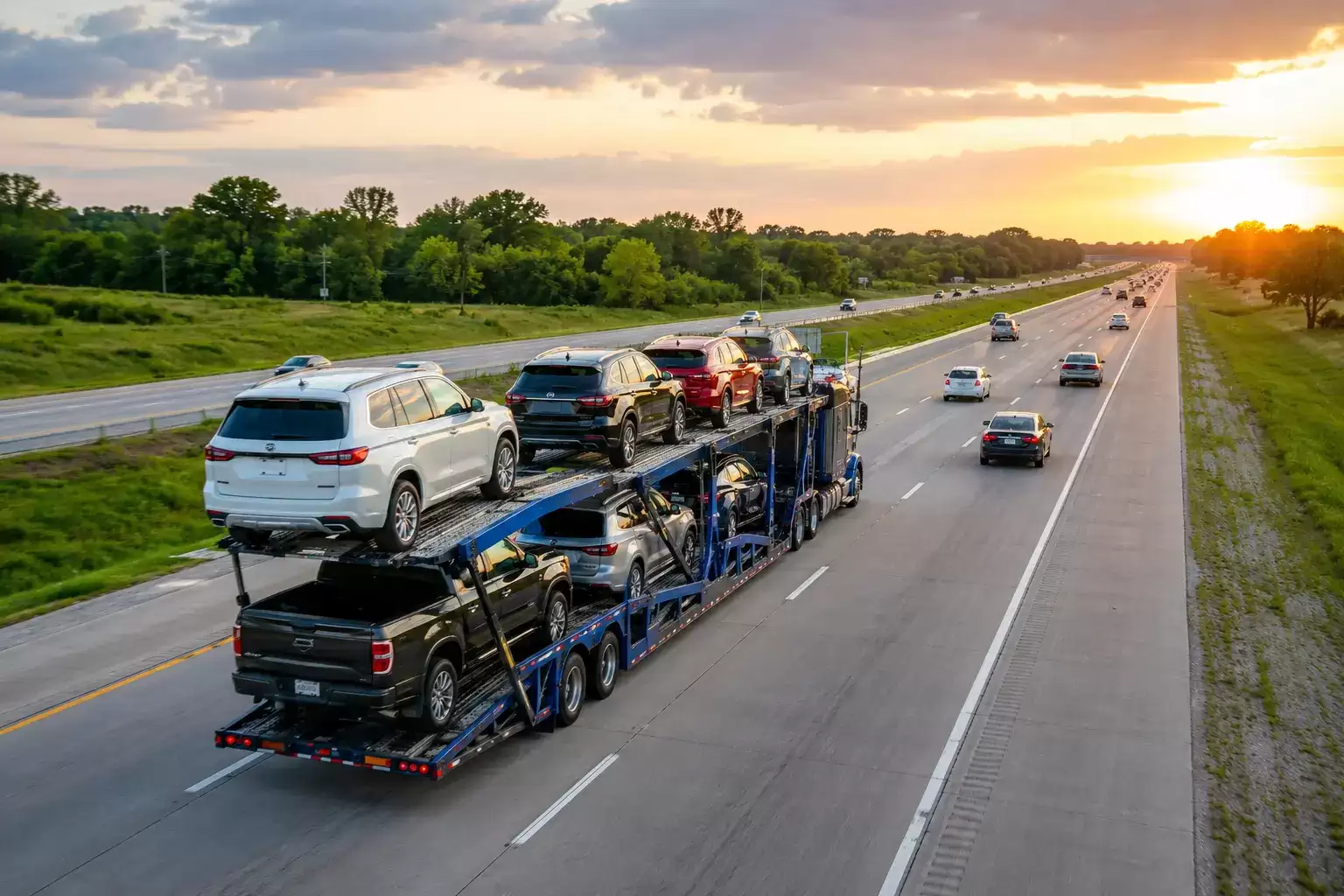
There are over 10,000 big vehicle haulers on the road at any time, moving cars and trucks between America’s 20,000 towns and cities. They usually carry about seven to ten vehicles.
Finding one for your route used to be like finding a needle in a haystack and required endless phone calls, until we introduced the Internet’s first instant online car shipping quote calculator. It changed the industry!
We vet all of our potential car transport carrier partners to weed out anyone who doesn’t meet our standards. That’s why Direct Express Auto Transport is considered the most reliable broker in the industry.
How Do I Arrange Auto Transport?
[00:58] It’s easy, thanks to the quote calculator we invented. Start by entering your location and where you want the vehicle shipped. Indicate the year, make, and model of the vehicle. Select whether it’s running or non-running, and choose whether you want an open or enclosed trailer. Then, just click to choose among three pricing tiers, all without having to enter your personal information or render any payment.
How Do the Pricing Tiers Work?
[01:29] The more you’re willing to pay for shipping, the more attractive your vehicle looks to a car transporter. And then the faster everything happens. Carrier assignment. Pick-up. And delivery.
All customers are competing for truck space and we help position ours according to their level of hurry. But we are exceptionally good at giving our customers the best chance. We do this by offering three unique pricing tiers.
Choose the Rush tier if you’re in a big hurry. Usually it will put you at the top of a crowded field of vehicles and the next carrier going your way chooses yours. Or maybe use Rush tier for a remote location to lure a carrier to come.
Choose the Expedited tier if you’re in somewhat of a hurry. We recommend Expedited in most situations because it separates your order from about half those waiting for only a nominal amount more. People are usually happy they did.
Choose the Standard tier if you’re not in a hurry, on a tight budget and willing to be patient. If there are not better paying vehicles nearby, a carrier will haul yours.
Where Can I Ship From Or To?
[02:48] Big cities are the easiest place to ship from or to because they’re surrounded by major highways and attract more truck traffic. Shipping from or to more rural locations away from metropolitan areas might take longer.
When Can I Expect Pickup?
[03:06] You tell us or enter online the earliest date you want the vehicle to be made available, which becomes a starting date. The pickup could be on the earliest date you select or sometime after that. It all depends on your location, the availability of drivers, and the pricing tier you select.
We take your information to our network of nationwide vehicle haulers and use our connections to help you secure a spot on a trailer.
How Long Does Shipping Take?
[03:37] Most carriers are anxious to get on the road and don’t want to wait around. They travel around 500 miles a day. Add a day or two for other vehicle pick-ups and drop offs. That’s how long the transit time normally takes.
How Do I Prepare My Vehicle?
[03:55] First, clean anything loose out of the interior. Remove any electronics, guns, narcotics, fireworks or explosive materials from the vehicle along with anything else of value. Store no more than 100 pounds of stuff in the back or trunk, and leave only ¼ tank of gas. Finally, snap a few pictures of the vehicle to document the condition.
What to Expect at Pickup?
[04:25] The driver or dispatcher will usually call your contact the day before and then again the day of pick-up. The trucks are big and usually cannot pull up to your house. In the spirit of door-to-door, the carrier selects a nearby meeting place, usually within a couple miles. You will give the vehicle hauler your keys, sign the Bill of Lading and Vehicle Condition Report. Note any dings or damage. No money changes hands and off your vehicle goes!
What to Expect at Delivery?
[04:57] Again the driver or dispatcher will usually call the day before and then again the day of delivery. The same spirit of door-to-door applies at delivery. Our carrier gets as close as he can.
Inspect your vehicle and note any damage on the BOL at the time of delivery. You should be given a copy. Take photos of the vehicle. Pay the carrier fee in Money Order or Cash. Your vehicle is fully insured up to $150,000.
If you have any more questions, please contact the team at Direct Express Auto Transport at 800-600-3750. We’re happy to help! Or book now online.
Select Your Speed: Three-Tiered Pricing
We pioneered a tiered system that lets you decide how your vehicle “competes” for space on a carrier’s trailer.
Standard Tier
Most Affordable
-
Assignment Window: Usually 1–8 days.
-
Best For: Flexible schedules with no hard deadline. If you’re not in a hurry and your route has steady carrier traffic, Standard puts you in the queue at the base market rate for trailer space. A good fit for common routes between major cities where trucks run frequently.
Expedited Tier
Recommended
-
Assignment Window: Usually 1–4 days.
-
Best For: Most customers shipping on a normal timeline. When multiple vehicles are competing for the same trailer space, a modest price increase makes yours significantly more attractive to carriers. Also the smart choice if you’re shipping from a smaller town or rural area where trucks need a little extra incentive to detour off the main lanes.
Rush Tier
FASTEST
-
Assignment Window: Usually 1–2 days.
-
Best For: Urgent moves with a firm deadline. Rush orders go to the top of the field — carriers see higher-paying loads first and pick them fast. If you’re on a tight timeline, relocating for work, or dealing with a last-minute situation, Rush gives you the best shot at same-day or next-day carrier assignment.
Frequently Asked Questions
How does auto transport work?
Auto transport works in four steps: you get a quote and book a carrier, a driver picks up your vehicle, your car travels on an open or enclosed trailer to its destination, and it is delivered and inspected. Your vehicle is insured throughout.
How long does auto transport take?
Short hauls under 500 miles take 1 to 3 days. Cross country shipments of 1,500+ miles generally take 7 to 10 days. Always build in a buffer when planning around a deadline.
Is my car insured during transport?
Yes. Federal law requires all licensed carriers to carry cargo insurance, typically $150,000 per load. You can request a Certificate of Insurance copy after your vehicle is assigned a carrier.
What is the difference between open and enclosed auto transport?
Open transport uses an open air trailer and is the most common and affordable option. Enclosed transport uses a covered trailer recommended for luxury, exotic, or classic vehicles and typically costs 30 to 50 percent more.
How much does auto transport cost?
Most domestic car shipments cost between $500 and $2,500. Request a free quote for your specific route and vehicle for the most accurate price.
How do I prepare my car for auto transport?
Remove all personal belongings, leave about a quarter tank of gas, photograph existing damage, check tire pressure, and disable toll transponders.
What is a Bill of Lading?
The Bill of Lading is the official inspection report signed at both pickup and delivery. Always inspect your vehicle before signing at delivery. Once signed, it becomes much harder to dispute any damage.
Direct Express Auto Transport
Frequently Asked Questions
Everything you need to know — from your first quote to final delivery
Getting a quote takes less than two minutes and you can do it entirely online — many customers tell us it is even quicker than calling in. Simply fill out our Quote Box with:
- The city and state you are shipping FROM and TO
- Open or Enclosed carrier type
- Whether your vehicle is Running or Non-Running
- How many vehicles (one or multiple)
- The year, make, and model of each vehicle
Hit “Get Your Car Shipping Quote Now” and your personalised, binding quote appears instantly on screen. You can also enter your email address to lock in that price for 7 days.
Yes! Every quote you receive is guaranteed for 7 full days. Just enter your email address in the quote form and we will send the quote directly to your inbox so you can refer back to it whenever you are ready. No obligation, no pressure.
Very little. You need to know the origin and destination cities, the year/make/model of the vehicle, and your preferred first available ship date. Everything else — contact names, exact addresses, and payment — is collected step-by-step after you choose your rate. You do not need your credit card until the very last step.
Everything can be handled 100% online, start to finish. Our booking process is designed so that a customer can complete an order just as fast — and often faster — than working with one of our Sales Representatives by phone.
Open transport is the standard, most popular option. Your vehicle rides on an open multi-car carrier — the same kind you see delivering new cars to dealerships every day. It is safe, reliable, and the most economical choice for the vast majority of vehicles.
Enclosed transport places your vehicle inside a fully covered trailer, protecting it from weather, road debris, and prying eyes. This is the preferred choice for high-value, exotic, classic, or low-clearance vehicles where maximum protection is the priority.
Absolutely. We ship non-running vehicles regularly. Just select “Non-Running” in the quote form. Non-running vehicles require specialised loading equipment (a winch or forklift), so there is typically a small additional fee reflected in your quote.
Be sure to let us know in the Vehicle Details section if your car has any other special circumstances — low ground clearance, oversized tires, or a lifted suspension — so we can match you with the right carrier.
Once your quote is generated you will see three clearly labelled options:
Your total is split into two portions for most orders:
- A partial credit card charge — processed at the moment your vehicle is assigned to a carrier.
- The balance — paid directly to the carrier driver upon delivery, in Cash or Money Order.
If you prefer to pay in full by credit card upfront (no cash or money order needed at delivery), that option is available at checkout. You can also optionally increase the carrier fee by $50, $100, or $200 — many customers find this helps attract a carrier more quickly.
No. Your credit card is only charged upon successful carrier assignment. If for any reason we are unable to assign a carrier, you will not be billed. We believe you should only pay when we deliver — and we mean that literally.
You will move through a short, guided checkout — just a few screens:
- 1Shipping Details & Date — Confirm your route, vehicle details, and select the first date your vehicle will be available to ship.
- 2Pickup Contact — Name, address, and phone of the person handing over the vehicle. Add a backup contact and indicate residential, business, or port.
- 3Delivery Contact — Same information for the person receiving the vehicle at the destination.
- 4Vehicle Details — Confirm year/make/model and note any special circumstances (convertible, lifted, oversized tires, low clearance).
- 5Payment — Enter credit card details and choose an optional carrier-fee increase. Nothing is charged yet.
Click “Book My Shipment” and you are done!
No — it is the earliest possible date you are willing for a carrier to pick up your vehicle. Think of it as opening the window, not scheduling a fixed appointment. Depending on the rate tier you selected, assignment and then pickup could happen anywhere from 1 to 8 days after that date. The sooner your window opens, the sooner we can find you a driver.
Yes, and we encourage it. During the order form you can designate a backup contact at both the pickup and delivery locations. This ensures the carrier can always reach someone, even if the primary contact is briefly unavailable — reducing any risk of a missed window.
Just check “Yes” on that question during the Pickup Contact step. This helps us coordinate with the facility’s specific operating hours, gate procedures, and release paperwork, ensuring a smooth and professional pickup on your behalf.
During the Vehicle Details step you will be asked whether your vehicle is a convertible, is lifted, has less than 5 inches of ground clearance, or has oversized tires. Please answer these accurately — they affect which carriers are a match for your vehicle and help us set the right expectations. No surprises on pickup day.
We hear this from customers all the time — yes, and often faster! Our streamlined online flow was built so every question has a clear answer and every step has clear instructions right on the page. You move at your own pace, with no hold times.
Within seconds of clicking “Book My Shipment,” you will receive an email Order Confirmation containing your unique Order ID number and all pertinent shipment details. Please save this email — it is your receipt. You can reach any member of our staff at 800-600-3750 or [email protected] and reference that Order ID at any time.
The moment we assign a carrier, you will receive a second email with the subject line: “Your Vehicle Has Been Assigned A Carrier.” We send this the very second the assignment is made. That email will contain:
- The carrier’s name and phone number
- The expected pickup date the carrier gave us
- The estimated delivery date
- The amount due to the carrier upon delivery (if applicable)
At the same moment this email goes out, your credit card partial payment will be processed.
Yes — they are expected to call you in advance, typically the day before and again on the morning of pickup. Carriers should never arrive unannounced.
The same standard applies. The carrier should call you from the road — usually the day before arrival — to give you a delivery window. If delivery is imminent and you have not heard from them, call us. The carrier wants to be on time; occasionally traffic, weather, or a prior delivery delay causes a schedule shift. Your patience is appreciated, and any tip you give the driver for good service is always very welcome.
Carriers typically cover around 500 miles per day. For example, the Miami, FL to Boston, MA route (1,492 miles) typically takes 3 to 5 transit days from pickup. Longer routes take longer; shorter routes can sometimes be faster. All dates given are estimates — we are very accurate in our predictions, but weather, traffic, and multi-stop routes can occasionally shift the timeline.
Damage complaints are extremely rare — roughly 1 in every 200 shipments — and when they do occur they are almost always minor. We still recommend maintaining your own personal auto insurance during transport as a belt-and-suspenders measure.
At pickup: Walk around the vehicle with the carrier driver and note any pre-existing marks or scratches on the Bill of Lading (the condition report the driver will present). Both parties sign it.
At delivery: Inspect the vehicle again in the presence of the carrier before signing the delivery receipt. Note any new marks immediately while the driver is still present — this is your opportunity to raise any concern. Once signed, the delivery is accepted as-is.
Complaints are rare, but documenting the condition at both ends protects everyone.
Anyone on our staff can help you — you are not limited to the representative who set up your order. Reach us any time by phone at 1-800-600-3750 or by email at [email protected]. Have your Order ID ready for the fastest service.
No taxes are added to your shipment. The price you see is the price you pay (plus the optional carrier-fee top-up if you choose it at checkout). We are committed to transparent, upfront pricing — no surprises.
Door-to-door means the carrier picks up as close to your origin address as legally possible for a large transport truck, and delivers as close to your destination address as possible. For most residential streets this is right at your door. Occasionally, in areas with very tight roads or low bridges, the driver may ask you to meet at a nearby open area — but this is the exception, not the rule.
Yes. Select “Multiple” in the quote form and add each vehicle’s year, make, and model. We will price and book all vehicles under a single order for your convenience.
The sooner the better — especially if you have a firm move date in mind. Booking at least 1–2 weeks ahead gives Standard and Expedited customers the most flexibility. If you need a vehicle moved in the next day or two, our Rush tier is built exactly for that, and we have a strong track record of delivering on it.
CVV is the 3-digit security code printed on the back of Visa, Mastercard, and Discover cards (or the 4-digit code on the front of American Express cards). It confirms that you are in physical possession of the card during the transaction. It is a standard security measure and is never stored after your order is processed.
A portion of your total is paid directly to the carrier driver upon delivery — in Cash or Money Order (not personal checks). At checkout you have the option to voluntarily increase this carrier-facing portion by $50, $100, or $200.
Decades Of Proven Experience
Expert Customer Service
Our seasoned pros provide the best advice for cross-country shipping. Need help? Call us at 800-600-3750.
Vetted Carrier Network
We have a network of over 10,000 carrier partners, allowing us to service every continental state with ease.