
Texas Car Shipping Services

Need to ship a car to or from Texas? Get a real-time, transparent price in 30 seconds — no phone calls, no risk, no upfront payment. Direct Express Auto Transport has been the Lone Star State’s most trusted auto transport broker since 2004, with a 4.6-star average across thousands of verified Google reviews.
Car Shipping Service Fast & Reputable

Texas Car Shipping Services

Need to ship a car to or from Texas? Get a real-time, transparent price in 30 seconds — no phone calls, no risk, no upfront payment. Direct Express Auto Transport has been the Lone Star State’s most trusted auto transport broker since 2004, with a 4.6-star average across thousands of verified Google reviews.

★ 4.6/5 Google Reviews  |  BBB Accredited A+  |  FMCSA Licensed (MC #479342)  |  USDOT #1240502  |  No upfront payment required  |  20+ years shipping vehicles

Geo City BBB Accredited Business Car Transport Services
Google Reviews for Car Shipping Services Nationwide

New to Texas car shipping? Watch this first!

Before you book, take six minutes to learn exactly how auto transport works — from getting your quote to handing over your keys and inspecting your vehicle at delivery. This video was created by our team and explains the full process in clear, simple language. It’s the same overview our customer service team provides to first-time car shippers every day.

Follow along to see how we manage Texas auto transport from the Gulf Coast port cities to the Big Bend frontier and from the Rio Grande Valley to the Red River.

[00:00] – Introduction to Texas Auto Transport
We begin by explaining why Texas is one of the most active vehicle shipping states in the country. Our carrier network is built around the I-35 NAFTA corridor — the busiest commercial truck route in North America — and the east-west I-10 and I-20 corridors that cross the state.

[00:58] – How To Arrange Auto Transport
Learn how easy it is to schedule your Texas shipment. Whether you’re shipping a truck from San Antonio to a new duty station or a family SUV from Chicago to Dallas, we explain how the booking process works and how carriers are assigned on Texas’s most active corridors.

[01:29] – How Pricing Tiers Work
Texas pricing can vary depending on the season, the corridor, and whether you are shipping to or from a primary hub or a more remote market. We explain how rates change throughout the year and how your location within Texas — from the densely served DFW metro to the more isolated West Texas and Panhandle communities — affects your quote.

[02:48] – Where We Ship
We transport vehicles throughout the entire state of Texas — from the Gulf Coast cities of Houston and Corpus Christi to the border communities of the Rio Grande Valley, the oil fields of West Texas, and the high plains of the Panhandle. If you’re in Texas, we ship there.

[03:06] – When To Expect Pickup
Pickup timing depends on route availability, carrier scheduling, and your chosen tier. We explain how pickup windows work on Texas’s diverse carrier network and how vehicles in more remote Texas communities can still be served efficiently by coordinating with carriers running major trunk routes.

[03:37] – How Long Shipping Takes
Get realistic transit time expectations for routes between Texas and destinations across the West Coast, the Northeast, the Midwest, and the Southeast — including how Texas’s own geographic scale affects intra-state and regional transit times.

[03:55] – Preparing Your Vehicle
Before pickup, we recommend cleaning your vehicle, removing personal items, and photographing every panel. For Texas-specific preparation: if shipping in summer, note that exterior temperatures on a parked open carrier can exceed ambient air temperature significantly. Ensure no flammable aerosols, liquids, or pressurized containers are left in the vehicle.

[04:25] – What To Expect At Pickup
We walk through the inspection and Bill of Lading process so you know exactly what happens when the carrier arrives at your Texas pickup location — whether that’s a residential driveway in the suburbs or a commercial address near one of the state’s military installations.

[04:57] – What To Expect At Delivery
The final inspection and delivery process is explained step by step, including how deliveries are handled in gated communities — common in Texas’s suburban growth corridors — and in areas with limited truck access such as historic downtown neighborhoods and urban cores in Austin and Fort Worth.

How Much Does It Cost to Ship a Car to/from Texas?

Texas car shipping costs vary based on your route, the time of year, vehicle size, and the service tier you choose. Use our instant calculator above for a real-time quote — or see the route-by-route pricing tables below for a fast ballpark. Most standard sedan shipments to or from Texas range from $625 on short regional hauls to neighboring states up to $1,800+ on cross-country routes to the Pacific Coast or the Northeast. Our Expedited and Rush pricing tiers hasten the process to create an even more satisfying experience.
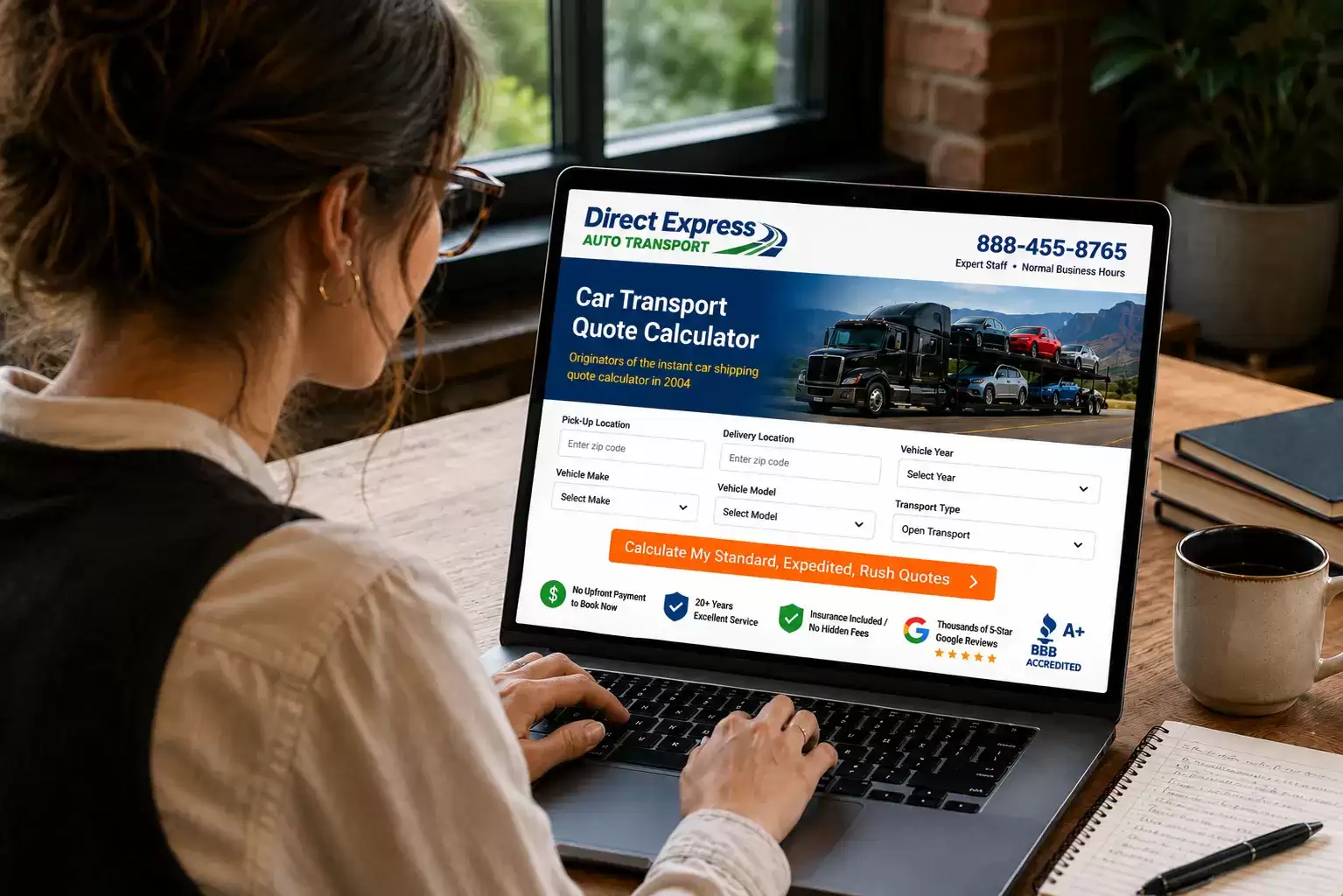
Texas Woman in office calculating online car shipping quote

What customers say about shipping a car to or from Texas with Direct Express Auto Transport

JD M.
3 months ago
Top-notch service. Scheduling was easy, pricing was fair, and the entire process was handled with professionalism. Pickup and delivery were seamless, and I appreciated the consistent updates along the way. My vehicle arrived exactly as expected—no issues at all. You can tell this company takes pride in what they do.
Char P.
3 months ago
Is worried about shipping my car w/ them but they talked me through it and they awesome my car was pick up no problem and delivered no problem everyone was professional i will definitely be using there services again
Anonymous R.
5 months ago
My experience was great! I paid for expedited shipping and pickup was set 4 days from that day. Direct express’s customer service is great. The carrier they picked did a good job and my car arrived in perfect condition within 3 days! All the stuff I left in the vehicle was intact.
Lesle C.
7 months ago
Booking with Direct Express Auto Transport via John was simple and completed quickly. I called and booked on Friday, their contracted hauler picked up my truck on Saturday afternoon. The truck was securely transported with delivery complete by dinner time on Sunday. The transport was from mid- florida to mid-Michigan! Fantastic job team! The price for an emergency transport was extremely reasonable. All conversations were positive with plan information complete in confirmation emails and up-date texts. I will definitely use their services again and highly reccomend Direct Express Auto Transport transport needs.
Sheri T.
9 months ago
There is a lot of anxiety shipping your car. However Direct Express
And their carrier Speedstar did an exceptional job.. everyone was
Courteous and the driver was extremely competent. They transported or car in 30 hrs from TX to MA. I would definitely use them again.
Adam
10 months ago
They did great. I had some unforeseen circumstances arise right before I was getting ready to ship my car. I had to change the pickup date twice. They were very patient and worked with me for the best outcome. I received my car a day early in good condition. I’ll be using them again in the future

Why Texas is one of the most active auto transport markets in the country

Texas is the second-largest state in the country by area and the second-largest by population — and it is one of the busiest states for auto transport in the continental United States. The combination of the nation’s highest-volume commercial truck corridor (I-35), massive military installations generating constant PCS vehicle shipping demand, two major Snowbird migration patterns, an explosive tech industry relocation boom, and the sustained “California Exodus” of residents relocating to the Dallas-Fort Worth, Austin, and Houston metros makes Texas a permanent high-priority corridor for carriers nationwide.

Texas is the only state with five metro areas in the top 25 of U.S. auto transport volume: Dallas-Fort Worth, Houston, San Antonio, Austin, and El Paso. The I-35 corridor running through all four of the first named cities is the most heavily traveled commercial vehicle route in North America, carrying more truck freight than any other interstate in the United States. For auto transport carriers, this means Texas routes are almost never empty in either direction — a structural efficiency that translates directly into competitive pricing and strong carrier availability for Texas shippers.

The California Exodus has permanently reshaped Texas auto transport over the past decade. Tens of thousands of California residents relocate to Texas annually, making California-to-Texas one of the most carrier-dense routes in the country. Carriers that run this route consistently find outbound loads heading west with relative ease, which keeps pricing competitive in both directions year-round.


The interstate corridors that move Texas vehicles

Four primary highway arteries define Texas’s auto transport network:

I-35 (NAFTA corridor): The most important auto transport route in Texas and the highest-volume commercial truck corridor in North America. It enters Texas at the Oklahoma border near Gainesville and runs south through Denton, Dallas-Fort Worth, Waco, Austin, San Antonio, and Laredo before crossing into Mexico. The concentration of Texas’s four largest cities along this single corridor gives it a carrier density matched by only one or two routes in the country. Vehicles shipping between Texas and the Midwest, the Great Plains, and the Pacific Northwest primarily use I-35 for their Texas segment.

I-10 (Southern Transcontinental corridor): The primary east-west artery through southern Texas. It enters from New Mexico near El Paso, crosses 880 miles of Texas through San Antonio, and exits into Louisiana east of Beaumont. I-10 is the main carrier route for vehicles moving between California, Arizona, and the Southeast — making Houston and San Antonio the primary Texas stops on cross-country runs. The I-10 Houston-to-Florida corridor is one of the busiest Gulf Coast auto transport routes in the country.

I-20 (Central Texas east-west corridor): Runs east from the New Mexico border through Midland, Odessa, Abilene, and the western DFW suburbs before exiting into Louisiana near Longview. I-20 is the primary routing for carriers connecting West Texas, the Dallas metro, East Texas, and the Southeast. The I-20/I-30 network east of Fort Worth carries significant volume on the Dallas-to-Atlanta corridor.

I-45 (Gulf Coast connector): Connects Dallas to Houston via Corsicana and Huntsville, then continues south to Galveston. I-45 is the primary carrier route between the DFW metro and Houston — the two largest Texas markets — and the main artery for vehicles moving between North Texas and the Gulf Coast. The Dallas-to-Houston run is one of the most frequently booked intra-Texas auto transport routes.

Vehicles shipping to or from Dallas-Fort Worth, Houston, San Antonio, or Austin benefit from the highest carrier frequency in the state — multiple daily departures in every direction. If you are shipping to West Texas, the Panhandle, the Rio Grande Valley, or rural East Texas, expect slightly longer pickup windows due to the deviation from primary carrier trunk routes. Expedited tier is recommended for these markets regardless of season.


Texas Auto Transporter delivering to 30 something couple
Texas car-transport-driver-strapping-down-a-blue-car-on-th-trailer

Texas as a crossroads: what it means for your vehicle shipment

Texas’s geography creates a carrier dynamic unlike that of any other major auto transport state. Unlike Florida (a peninsula where carriers drive in and out along the same limited corridors) or California (a terminus where every carrier must find a return load), Texas is a true crossroads state. Carriers can enter and exit Texas in six directions, and they do — constantly. This has three important implications for shippers:

No single dominant direction: Florida sees massive southbound fall surges and northbound spring surges. California sees sustained inbound and outbound demand balanced by the California Exodus. Texas sees meaningful carrier traffic in all directions simultaneously, year-round. A carrier delivering a vehicle to Dallas from Chicago can pick up a load heading east to Atlanta, south to San Antonio, or west to El Paso within hours. This multi-directional flexibility is why Texas carrier availability is among the most consistent in the country.

The I-35 NAFTA advantage: The busiest commercial truck corridor in North America runs directly through Texas’s four largest cities. Carriers running I-35 between the Midwest and Mexico have financial incentive to pick up auto transport loads along the corridor to offset fuel costs. This creates a structural carrier density on the Dallas-to-San Antonio segment that few corridors in the country can match. Standard tier pickup windows in DFW and San Antonio are among the shortest in the nation as a result.

Texas’s own scale creates regional pricing: Texas is so large that intra-state shipping — Dallas to El Paso (625 miles), Houston to Amarillo (500 miles), San Antonio to Corpus Christi (210 miles) — prices like a mid-to-long-haul interstate route. Carriers within Texas treat it as its own regional market. This means that shipping a vehicle from Dallas to El Paso may cost as much as shipping from Dallas to Kansas City, despite being entirely within the same state.

Southbound into the Rio Grande Valley (Oct–Mar): High inbound demand as Midwest Snowbirds flood into McAllen, Harlingen, and Brownsville. I-35 southbound carriers fill quickly. Pricing firms and pickup windows depend on your chosen tier.

Northbound out of Texas (Mar–May): Snowbirds returning north create favorable conditions for northbound Texas shipments. Carriers who delivered southbound loads are eager to fill trailers for the return trip, producing competitive rates on northbound I-35 routes during this period.

Summer (Jun–Sep): Military PCS season drives both directions to their annual peak simultaneously across all Texas corridors. Summer is Texas’s most expensive period for both inbound and outbound auto transport — the opposite of Florida’s summer bargain window.

Texas’s major auto carrier hubs and what they mean for you

Not all Texas cities are equal from a logistics standpoint. Here is how the major hubs rank in terms of carrier availability:

Dallas-Fort Worth: Highest carrier density in Texas and one of the top five auto transport metro areas in the United States. The DFW metro sits at the convergence of I-35, I-30, I-20, I-45, and I-635, giving carriers arriving from any direction immediate access to outbound loads in every other direction. Daily departures to virtually every major U.S. city. Standard tier pickup windows in DFW rival those of Los Angeles and Miami for speed on major corridors.

Houston: Texas’s Gulf Coast hub and the I-10 corridor anchor. The Port of Houston creates additional vehicle import and export activity that supplements domestic auto transport demand. I-10 east connects to the Southeast and Florida; I-10 west connects to San Antonio and ultimately California; I-45 connects north to Dallas and south to Galveston. Year-round carrier frequency is excellent. Houston’s petrochemical and energy industry drives consistent corporate relocation demand independent of seasonal patterns.

San Antonio: The I-35 corridor midpoint between Dallas and Laredo, and the headquarters of Joint Base San Antonio — one of the largest military installation complexes in the country. San Antonio generates more military vehicle shipping demand per capita than almost any other major U.S. city. The I-10 east-west junction gives it access to both the California corridor and the Florida corridor simultaneously. Fast pickup windows year-round.

Austin: The fastest-growing auto transport market in Texas over the past decade, fueled by the tech industry relocation boom that has brought thousands of California, New York, and Illinois residents to the Austin metro annually. I-35 puts Austin between Dallas and San Antonio on the NAFTA corridor, giving it carrier access comparable to both. The University of Texas contributes significant student vehicle demand in August and May.

El Paso: Western Texas hub and I-10 border city. Fort Bliss, one of the Army’s largest installations, generates significant military PCS demand. El Paso functions as the eastern terminus for carriers running California-to-Texas on I-10, meaning inbound carrier availability from the west is consistently high. Outbound to California is similarly well-served.

Corpus Christi: South Texas port city on I-37 and the Gulf Coast. Naval Air Station Corpus Christi drives military vehicle shipping demand. Carrier availability is strongest during the Snowbird season when South Texas inbound traffic is at its peak. Port of Corpus Christi creates additional international vehicle shipping activity.

Lubbock: Texas Panhandle tech hub and home to Texas Tech University. US-84 and I-27 access. Moderate carrier activity that strengthens significantly during university move-in season in August. Expedited tier recommended for tighter timelines.

Amarillo: I-40 junction city in the Texas Panhandle. Carriers running the I-40 California-to-Midwest corridor pass directly through Amarillo, giving it stronger carrier access than its population size alone would suggest. East-west availability is generally good; north-south routes from Amarillo are more limited.

Rio Grande Valley (McAllen / Harlingen / Brownsville): South Texas Snowbird destination cluster. Carrier availability is strongest from November through March when Midwest Snowbirds fill the valley. Outside Snowbird season, this is one of the more challenging Texas markets for carrier availability. Expedited tier is strongly recommended year-round for Rio Grande Valley shipments.

Texas Vehicle Transporter delivering to 70 something snowbird

Texas car shipping cost estimates: major routes

The tables below show estimated pricing for the most commonly requested Texas auto transport routes, based on real-time market data for a standard operable sedan via open carrier. All prices reflect current market conditions for Standard, Expedited, and Rush tiers. Your actual quote may vary based on vehicle size, exact pickup/delivery zip codes, and seasonal demand. Use our instant calculator for a real-time rate.

Popular Routes To Texas

Swipe to view full table →

From To Distance (mi) Estimated Days Standard Expedited Rush
California Texas 1,430 3-5 $1,000 $1,200 $1,400
New York Texas 1,760 4-6 $1,160 $1,390 $1,625
Florida Texas 965 3-5 $890 $1,070 $1,245
Illinois Texas 1,190 3-5 $975 $1,170 $1,365
Minnesota Texas 1,450 4-6 $1,015 $1,220 $1,420
Michigan Texas 1,400 3-5 $980 $1,175 $1,370
Ohio Texas 1,400 3-5 $980 $1,175 $1,370
Pennsylvania Texas 1,710 4-6 $1,130 $1,355 $1,580
Colorado Texas 790 2-4 $790 $950 $1,105
Washington Texas 2,130 5-7 $1,300 $1,560 $1,820

Popular Routes From Texas

Swipe to view full table →

From To Distance (mi) Estimated Days Standard Expedited Rush
Texas California 1,430 3-5 $1,000 $1,200 $1,400
Texas Florida 965 3-5 $890 $1,070 $1,245
Texas New York 1,760 4-6 $1,160 $1,390 $1,625
Texas Arizona 850 2–4 days $650 $765 $905
Texas Georgia 790 2–4 days $625 $735 $870
Texas Colorado 790 2-4 $790 $950 $1,105
Texas Illinois 1,190 3-5 $975 $1,170 $1,365
Texas Nevada 1,230 3–5 days $725 $855 $1,010
Texas North Carolina 1,400 4–6 days $775 $915 $1,080
Texas Washington 2,130 5-7 $1,300 $1,560 $1,820

Why regional routes to Texas have a higher cost per mile than cross-country shipments

On a 1,430-mile California to Texas car shipment, carriers run an efficient transcontinental route and combine multiple vehicles heading the same direction, spreading fixed costs across more miles. On shorter hauls like Texas to Oklahoma at 200–350 miles, the per-mile rate is actually higher because the carrier covers fewer miles per stop. This is why shipping a car from Dallas to Denver ($625) costs more per mile than shipping it from Dallas to New York ($895).


Young Couple getting an instant Texas car shipping quote on the Direct Express Auto Transport calculator

Best time to ship a car to or from Texas — the complete seasonal guide

Texas auto transport has a unique seasonal profile driven by two distinct demand spikes: the Rio Grande Valley Snowbird migration from October through March, and the military PCS and corporate relocation peak from June through August. Unlike most states, Texas never has a true bargain season — but pricing and carrier availability do shift meaningfully by corridor and direction throughout the year. Here is what you need to know:

Swipe to view full table →

Period Inbound (into Texas) Outbound (from Texas)
Oct – Nov HIGH demand. Rio Grande Valley Snowbird migration begins. Midwest retirees from Minnesota, Michigan, Wisconsin, and Iowa heading south on I-35. Book Expedited 2–3 weeks ahead. Rates rising on southbound corridors. MODERATE demand. Post-summer slowdown creates Texas’s best outbound window. Good rates on California, Pacific Northwest, and East Coast runs. Carriers seeking return loads from southbound Snowbird deliveries. Standard tier often assigns in 3–5 days outbound.
Dec – Feb PEAK southbound demand. Rio Grande Valley Snowbird season at full capacity. Midwest retirees filling the McAllen, Harlingen, and Brownsville areas. I-35 southbound carriers booking quickly. Book Expedited 2–4 weeks ahead for South Texas arrivals. MODERATE. California Exodus carriers coming into Texas seek return loads westbound. January is competitive for outbound Texas shipments to California and the Pacific Northwest. Some capacity northbound as carriers turn around from Snowbird deliveries.
Mar – May HIGH demand. California Exodus peaks as spring tech hiring drives massive inbound from Bay Area and Southern California. Corporate relocation season begins. DFW and Austin see strongest spring inbound. Book Expedited. HIGH demand. Snowbirds returning to Minnesota, Michigan, and Wisconsin. Northbound I-35 corridors competitive. Book Expedited for reliable timing. Best rates of spring for Texas-to-Southeast and Texas-to-East Coast runs heading into April.
Jun – Sep HIGHEST RATES of the year. Military PCS season peak at Fort Cavazos, Joint Base San Antonio, and Fort Bliss. Corporate relocation season. University move-ins at UT Austin, Texas A&M, and Texas Tech in August. Book Expedited or Rush for hard deadlines. HIGH demand. Matching summer relocation surge outbound. Military transfers out of Texas bases at annual high. Tech industry moves to California, Seattle, and New York drive outbound volume. Peak rates in both directions. Expedited strongly recommended.

The Rio Grande Valley Snowbird booking window and summer PCS season — the two most important timing rules in Texas car shipping

Texas has two annual demand spikes that every shipper should plan around, and the booking strategy for each is the same: book early and choose Expedited.

Rio Grande Valley Snowbird season (October through March): Each fall, tens of thousands of retirees from Minnesota, Michigan, Wisconsin, Iowa, and the Dakotas travel south on I-35 to winter in the Rio Grande Valley communities of McAllen, Harlingen, Pharr, and Brownsville. Many ship their vehicles ahead of their own arrival. Carrier space on southbound I-35 fills quickly from mid-October onward. Here is the booking timeline:

October arrivals: Book 7–10 days in advance and select Expedited. Carrier demand for southbound South Texas runs builds in late September as the first wave of Snowbirds departs Minnesota and Michigan.

November–December arrivals: Book 7–10 days in advance and select Expedited. This is the most competitive window of the year on the I-35 Midwest-to-Texas southbound corridor. Standard tier can result in 10-day or longer waits during peak weeks.

January–February arrivals: Rates are at their annual peak for southbound South Texas. Rush tier is worth considering for hard move-in dates. Book 7–10 days ahead minimum.

Spring return March–May: Book 7–10 days in advance for northbound shipments from the Rio Grande Valley and South Texas. Carrier demand surges as Snowbirds head home. Expedited or Rush for a smooth timeline.

Military PCS season (June through August): This is Texas’s second and equally significant demand spike. Fort Cavazos (formerly Fort Hood) near Killeen is the largest active-duty Army base in the United States. Joint Base San Antonio consolidates three major installations in the state’s second-largest city. Fort Bliss in El Paso is one of the Army’s largest stateside bases. When PCS orders go into effect in June, vehicle shipping demand at all three installations surges simultaneously. Book as early as your PCS orders allow and choose Expedited or Rush for any hard reporting date.

Hurricane season, tornadoes, and car shipping in Texas

Texas faces two distinct severe weather threats that can affect auto transport: Gulf Coast hurricanes and Tornado Alley severe weather.

Gulf Coast hurricane season runs June 1 through November 30, with peak risk in August through October. Houston, Beaumont, Port Arthur, Corpus Christi, and Galveston face the highest risk from direct landfalls and tropical storm impacts. For the vast majority of shipments, hurricane season has no impact — carriers monitor weather continuously and reroute around storm systems proactively. If a major hurricane threatens your pickup or delivery area, your carrier will contact you to reschedule. Direct Express Auto Transport has no cancellation fees. Enclosed transport is worth considering during the August–October peak hurricane period for luxury, classic, or high-value vehicles shipping along the Gulf Coast corridor.

Spring severe weather and tornadoes affect North Texas and the Panhandle primarily from March through May. I-35 and I-40 through North Texas and the Oklahoma border region can face temporary closures during significant tornado outbreaks or hail storms. Carriers monitor conditions actively and hold loads at safe staging points during severe weather events. Delays from severe weather rerouting are typically measured in hours, not days. If you are shipping during spring and have a hard delivery deadline, Rush tier reduces your exposure to weather-related delay risk by accelerating the initial pickup and transit schedule.

Winter ice storms present a third, underappreciated risk in Texas. The February 2021 winter storm demonstrated that I-35 and I-20 can face multi-day closures during extreme cold events. While historically rare, winter ice events in Texas tend to be more disruptive than equivalent events in northern states because the infrastructure is not prepared for sustained below-freezing conditions. If shipping in January or February, Expedited tier is recommended so your vehicle is in transit — and insulated from ground-level logistics delays — before any potential weather window arrives.

September and October: Texas auto transport’s overlooked booking window

Late September through October is the best-kept window in Texas auto transport for both inbound and outbound shipments. The summer military PCS rush subsides in August, and the first significant wave of Snowbird migration southbound on I-35 does not typically build until mid-to-late October. This creates a 4–6 week gap in late September and early October where Texas carrier availability is at its annual peak relative to active demand.

During this window, Standard tier pickup windows on most major Texas corridors — Dallas to California, Houston to Atlanta, San Antonio to Chicago — match what Expedited tier typically delivers during summer. If your timeline is flexible and you can ship between September 15 and October 15, this is when you get the best combination of speed and price in Texas auto transport. The window closes quickly once the Rio Grande Valley Snowbird season builds momentum in October and November.

Standard, Expedited, or Rush — which tier is right for your Texas shipment?

Direct Express Auto Transport pioneered the three-tiered pricing model that is still for the most part unique to us. Each tier represents a different level of carrier incentive — the higher the tier, the more attractive your shipment is to carriers on the dispatch board, and the faster your vehicle gets assigned. Here is how each tier performs specifically on Texas routes:

Swipe to view full table →

Tier Best for Texas when… What to expect
Standard September–October window, flexible timeline on DFW or Houston routes, any shipment with a 10+ day pickup window Assignment in 4–8 days on major corridors. Best value when you are not in a rush and can let the market work for you on a high-volume route.
Expedited
(most popular)
Rio Grande Valley Snowbird season Oct–Mar, summer military PCS season Jun–Aug, any route to/from West Texas or South Texas year-round Assignment in 1–4 days. Strongly recommended for all Texas routes during peak seasons and year-round for secondary markets like Lubbock, Amarillo, and the Rio Grande Valley.
Rush Hard PCS reporting date, hurricane or severe weather window, last-minute corporate relocation, hard move-in deadline during summer or Snowbird peak Priority dispatch, often assigned within 24–48 hours. Best for any Texas shipment where the pickup date is non-negotiable.

The Texas-specific tier recommendation

On most Texas routes, Expedited is the tier we recommend most often — and not just during peak season. Texas has two annual demand spikes, a sprawling secondary market that regularly tightens carrier availability, and military base demand that can activate any route unexpectedly when large PCS orders go out simultaneously. The difference between Standard and Expedited is typically $100–$175 on a major Texas corridor, and that premium reliably shortens pickup windows from a week or more to 1–4 days.

Standard tier works well for: shipments from major hubs (DFW, Houston, San Antonio, Austin) during the September–October window, routes with genuinely flexible 10–14 day pickup windows, and budget-conscious shippers on high-volume corridors like Dallas to Chicago or Houston to Atlanta where carrier competition is strong year-round.

Rush tier is the right call for: military PCS moves with hard reporting dates, any shipment during a declared hurricane watch for the Gulf Coast, last-minute relocations during summer peak, and vehicles that need to arrive at a Texas dealership or auction by a fixed date.

young Texas woman in her 30s watching her non-running car get loaded

How to ship a car to or from Texas: 4 steps

Step 1: Get your instant Texas car shipping quote
Enter your pickup and delivery zip codes, your vehicle year, make, and model, whether it runs, and your preferred transport type (open or enclosed). Our calculator returns a real-time market rate in under 5 seconds. No name, phone number, or email required — you get the price first, every time.

Step 2: Choose your tier and confirm your dates
Select Standard, Expedited, or Rush based on your timeline and the seasonal guidance above. Enter your first available pickup date — you don’t need a firm date, just the earliest day the vehicle can be ready. For military PCS moves, enter your first available date even if orders are not finalized; our dispatch team can adjust as your reporting date firms up.

Step 3: Secure your spot — no upfront payment
Complete your booking online or by phone. Your credit card is on file but not charged until a carrier is assigned to your shipment. There is no deposit, no cancellation fee, and no obligation until assignment. Once matched, you receive the carrier’s name, phone number, and estimated pickup date by email.

Step 4: Door-to-door pickup and delivery
Your carrier calls your pickup contact 12–24 hours before arrival to confirm timing and the meeting location. For dense Texas cities — downtown Dallas, Austin’s East Sixth corridor, Houston’s Montrose neighborhood — the driver may coordinate a safe nearby meet point if residential streets cannot accommodate a 75-foot transporter. At delivery, inspect your vehicle thoroughly, note any issues on the Bill of Lading, and pay the carrier the balance due by cash or money order.

Shipping a Car to or From a Texas College or University

Texas is home to some of the largest universities in the United States, including Texas A&M University — the largest university in the country by enrollment. The combination of massive student populations, high out-of-state enrollment, and the state’s distance from major Northeast and Midwest population centers makes university vehicle transport one of Texas’s most consistent demand drivers. The universities below each have a significant enrollment and represent major auto shipping demand centers, especially in August, December, and May.

Swipe to view full table →

University Location Approx. Enrollment
Texas A&M University College Station ~74,000
University of Texas at Austin Austin ~51,000
University of Houston Houston ~47,000
University of North Texas Denton ~44,000
University of Texas at Arlington Arlington ~43,000
Texas Tech University Lubbock ~40,000
Texas State University San Marcos ~38,000
University of Texas at San Antonio San Antonio ~34,000
Sam Houston State University Huntsville ~22,000
Baylor University Waco ~21,000
Texas Christian University Fort Worth ~12,000

Tips for college car shipping: Book 2 to 3 weeks ahead of move-in dates. August is the single most competitive month for Texas university auto transport, with Texas A&M, UT Austin, Texas Tech, and UNT all beginning classes within days of each other. Door-to-door delivery is available to most campus areas; carriers coordinate nearby staging points for campuses with limited truck access.

College students preparing to ship a car to a Texas university
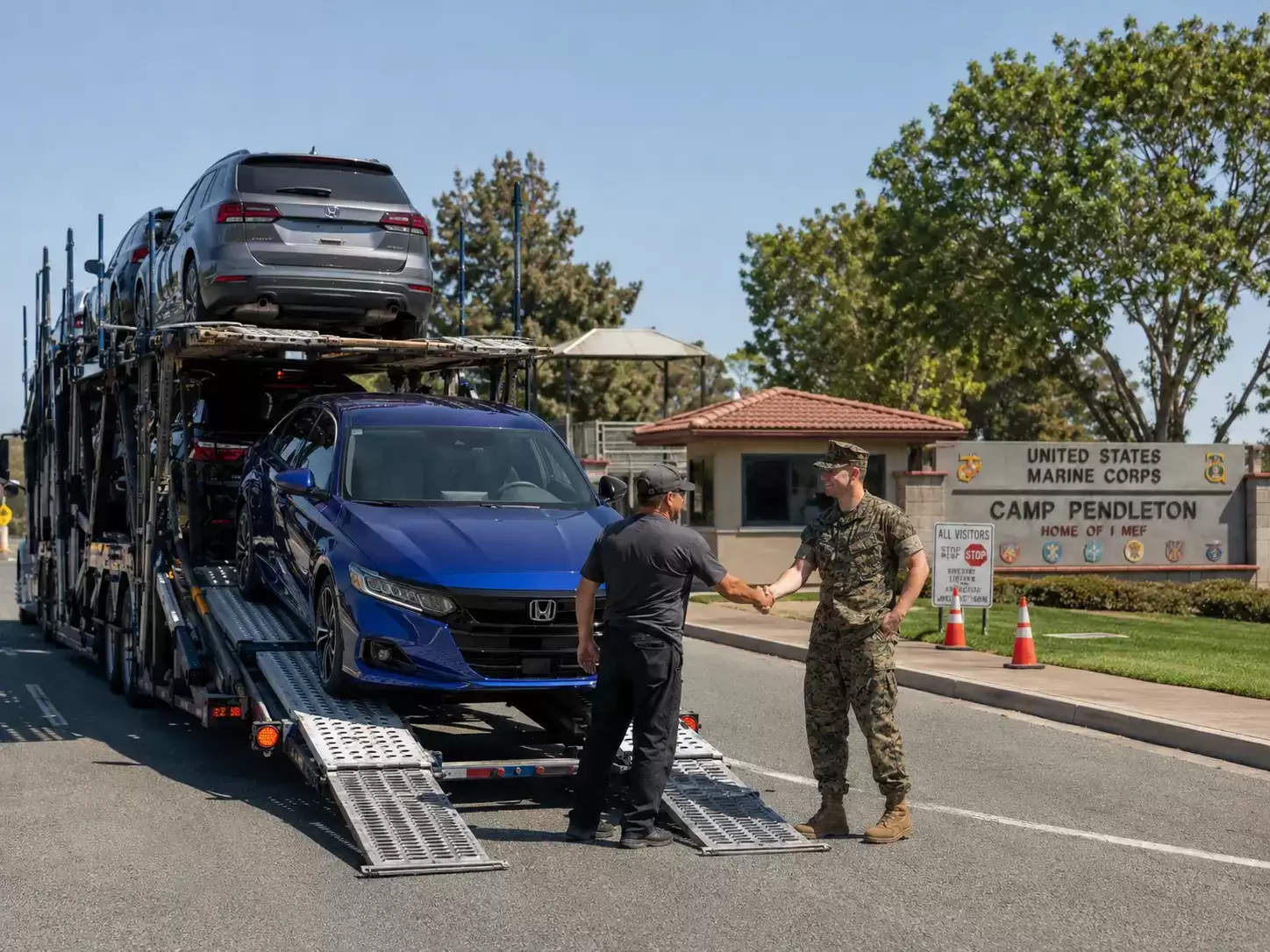
California Military base car shipping customer delivery

Military Car Shipping to and From Texas Bases

Texas has more active-duty military personnel than all but a handful of states. Three of the nation’s largest Army installations are in Texas, along with major Air Force and Navy facilities. PCS vehicle shipping to and from Texas military installations is a cornerstone of the state’s auto transport market year-round, with the June–August PCS peak representing one of the most demanding shipping windows in the country.

Fort Cavazos (formerly Fort Hood) — Killeen
The largest active-duty Army installation in the United States by population, home to the III Armored Corps. Fort Cavazos generates more PCS vehicle shipping volume than any other single installation in the country. The surrounding Killeen, Temple, and Copperas Cove communities absorb a massive annual flow of service members arriving and departing. I-35 access through Waco gives Fort Cavazos reasonably good carrier availability, though the PCS peak from June through August requires Expedited or Rush tier for any hard reporting date.

Joint Base San Antonio — San Antonio
One of the largest military complexes in the world, JBSA consolidates Lackland Air Force Base, Randolph Air Force Base, Fort Sam Houston, Camp Bullis, and Camp Stanley into a single joint command. San Antonio’s position on I-35 and I-10 means carrier availability is among the best of any military market in Texas. The city’s I-35 position between DFW and Laredo ensures consistent carrier density in all directions. Military families at JBSA benefit from some of the shortest PCS pickup windows in Texas even during peak season.

Fort Bliss — El Paso
One of the Army’s largest stateside installations, Fort Bliss occupies more than 1.1 million acres straddling the Texas-New Mexico border at El Paso. As the I-10 gateway between California/Arizona and Texas, El Paso sees strong carrier availability for westbound shipments to California, Arizona, and Nevada. Eastbound to the Dallas metro and San Antonio is also well-served. Fort Bliss service members shipping vehicles to or from Hawaii, Korea, or Germany typically ship to a port of embarkation (usually Los Angeles) using our domestic service first.

Naval Air Station Corpus Christi — Corpus Christi
Texas’s primary Navy installation and one of the nation’s largest naval air training commands. NAS Corpus Christi generates consistent PCS vehicle demand on I-37 north to San Antonio, and service members frequently ship vehicles to or from East Coast Navy installations in Virginia, Florida, and Maryland. Carrier availability improves significantly from October through March during the Snowbird season when South Texas inbound traffic is at its highest.

Dyess Air Force Base — Abilene
Home to the 7th Bomb Wing (B-1B Lancer) and a C-130J airlift unit. Dyess AFB is located in Abilene on I-20 between Midland-Odessa and DFW. Its I-20 position gives it carrier connectivity to both West Texas and the DFW metro, though Abilene’s relative distance from major carrier hubs means Expedited tier is recommended for PCS moves with tight timelines.

Sheppard Air Force Base — Wichita Falls
One of the Air Force’s largest technical training bases, Sheppard hosts NATO pilot training and processes a significant volume of international and domestic students annually. Located near the Oklahoma border on US-287, Wichita Falls is served by carriers running between DFW and the Oklahoma City/Midwest corridor. Vehicle shipping here benefits from I-44 connectivity north into Oklahoma and south toward DFW.

Naval Air Station Joint Reserve Base Fort Worth — Fort Worth
NAS JRB Fort Worth sits inside the DFW metro, giving it access to the highest carrier density in Texas. Reserve and active duty personnel here benefit from the same carrier availability as the broader DFW market, with vehicle shipping availability that is among the best of any military installation in the country.

Laughlin Air Force Base — Del Rio
Located on the US-90 corridor near the Mexican border in Val Verde County. Laughlin is one of the more isolated Texas military markets from a carrier access standpoint. Most loads stage through San Antonio before the final leg to Del Rio. Expedited tier is strongly recommended for all Laughlin vehicle shipments regardless of season.

A note for military members: Always verify whether your branch covers POV (Privately Owned Vehicle) shipment costs under your PCS orders before booking. Many service members at Texas installations choose private auto transport for speed, flexibility, or to ship a second vehicle not covered under government-arranged transport.

Texas Helpful Government Links

  1. Texas Department of Motor Vehicles (TxDMV) — The primary resource for registering and titling a vehicle after it arrives in Texas. New Texas residents must register their vehicle within 30 days of establishing residency.
  2. TxDMV — New Resident Vehicle Registration — Covers what out-of-state residents need to do to transfer a vehicle title and obtain Texas plates after relocating to the state.
  3. Texas Department of Public Safety — Vehicle Inspection — Texas requires an annual vehicle safety inspection and, in certain counties, an emissions inspection. Vehicles being registered in Texas for the first time must pass inspection before plates are issued.
  4. FMCSA — Verify a Carrier’s License (SAFER System) — The Federal Motor Carrier Safety Administration’s carrier lookup tool. Verify that any auto transport company you consider is federally licensed and insured before booking.
  5. FMCSA — Protect Your Move — Federal consumer guidance about hiring vehicle shippers, including scam warnings and shipper rights.
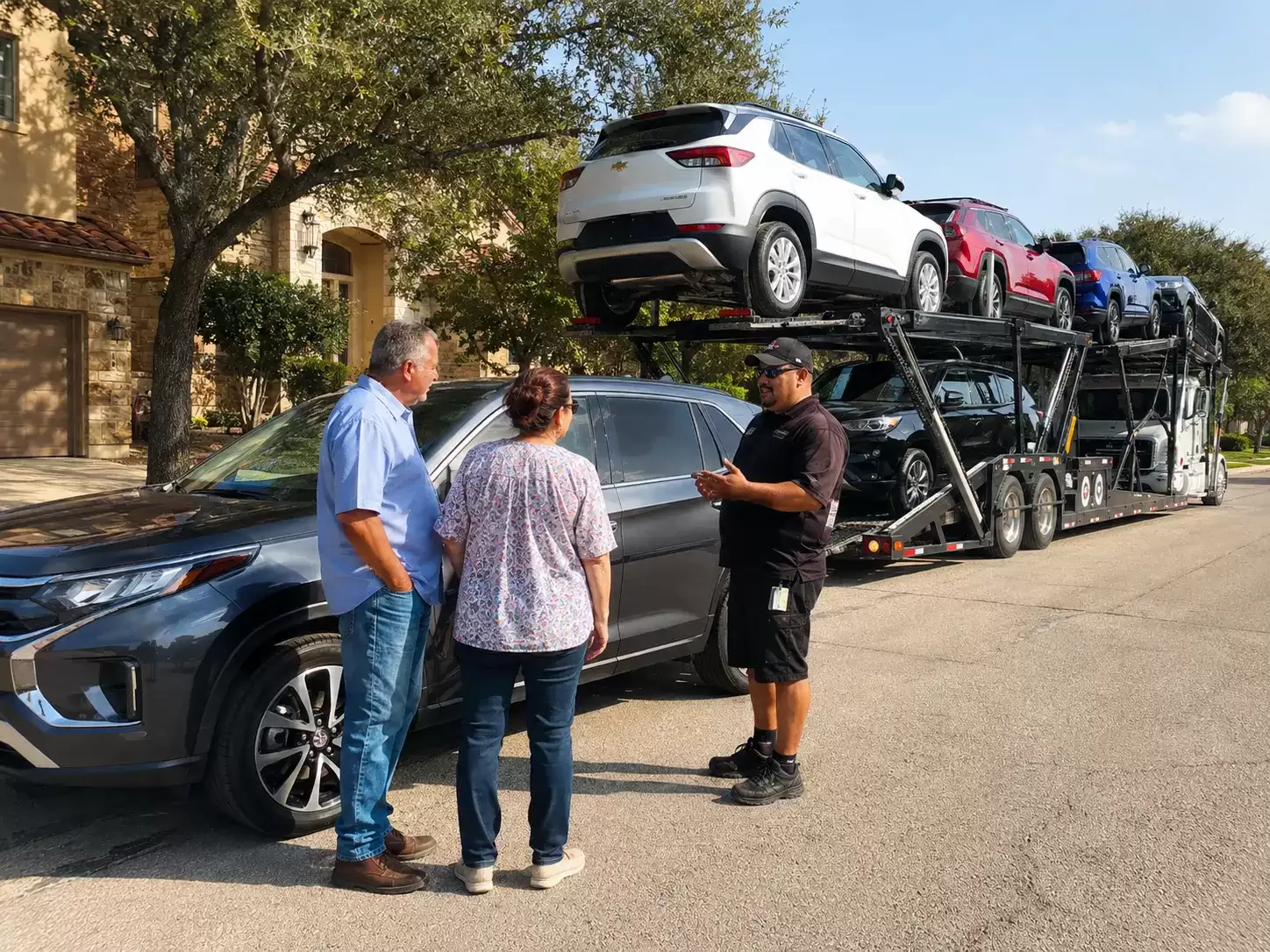
Texas Car Transporter delivering to 50 something couple

Popular Long Distance Routes From or To Texas

Texas to California Car Shipping

The Texas-to-California corridor is one of the most carrier-dense routes in the country, fueled by the sustained California Exodus of residents relocating to Dallas-Fort Worth, Austin, and Houston from the Bay Area, Los Angeles, and San Diego. Carriers running this corridor find loads heading in both directions with consistency unmatched by most long-haul routes. At 1,400–1,700 miles via I-10, Standard transit runs four to six days. Outbound California-to-Texas demand remains one of the strongest one-way freight patterns in domestic auto transport. Expedited availability on this corridor is consistently excellent even during peak periods.

Texas to Florida Auto Transport

The I-10 Gulf Coast corridor between Texas and Florida is one of the most active cross-state auto transport routes in the Southeast. At approximately 960 miles, Standard transit runs two to four days. Houston is the primary Texas origin for Florida-bound shipments, with San Antonio also well-served on the I-10 corridor. Military transfers between Joint Base San Antonio and MacDill AFB, Patrick SFB, and NAS Jacksonville contribute consistent demand. The Florida Snowbird reverse migration drives peak inbound Texas demand from Florida residents heading to Texas winter destinations in the Hill Country and Rio Grande Valley.

Texas to New York Vehicle Shipping

New York is the most common East Coast destination for Texas vehicle shipments, primarily serving the Dallas-to-NYC and Houston-to-NYC corporate and lifestyle relocation corridors. At approximately 1,760 miles via I-30 or I-20 east and I-95 north, Standard transit runs five to seven days. New York-to-Texas inbound demand has grown significantly as Texas’s corporate relocations have attracted major companies moving from the New York metro area to the DFW and Austin markets.

Texas to Illinois Car Transport

Chicago is the Midwest’s primary auto transport hub and a major destination for Texas vehicle shipments. At approximately 1,200 miles via I-35 north and I-55, Standard transit runs three to five days. Chicago’s central logistics position means loads from Texas destined for the broader Midwest often route through Chicago before final delivery to Wisconsin, Michigan, Indiana, or Ohio. The Dallas-to-Chicago I-35/I-55 corridor is one of the most efficient mid-distance vehicle shipping routes in the country.

Texas to Ohio Auto Shipping

Ohio and Texas share a consistent auto transport relationship driven by corporate relocations, university student moves, and military family transfers. At approximately 1,400 miles, Standard transit runs four to six days. Columbus, Cleveland, Cincinnati, and Dayton are the primary Ohio destinations. The I-35/I-44/I-70 corridor connects Texas to Ohio efficiently through Oklahoma City and St. Louis.

Texas to Michigan Vehicle Transport

The automotive industry’s presence in Michigan and Texas’s growing manufacturing base create a meaningful vehicle shipping relationship between the two states. At approximately 1,400 miles, Standard transit runs four to six days. Detroit, Grand Rapids, Flint, and Lansing are the primary Michigan destinations. The I-35/I-44/I-75 corridor provides the primary routing.

Texas to Georgia Car Shipping

Georgia is one of the most actively booked Southeast destinations for Texas vehicle shipments. Atlanta’s emergence as a logistics and entertainment hub has grown the Texas-to-Georgia corridor significantly. At approximately 790–900 miles, Standard transit runs two to four days via I-20. Military transfers between Texas installations and Fort Moore, Robins AFB, and Moody AFB add consistent demand. This is one of the most efficient mid-distance routes in the southern United States given I-20’s direct connection between the DFW metro and Atlanta.

Texas to Washington State Auto Transport

The Texas-to-Washington corridor, primarily serving the Dallas-to-Seattle and Houston-to-Seattle connections, carries tech industry relocation demand in both directions as Amazon, Microsoft, and Boeing draw Texas talent and Texas draws Pacific Northwest talent seeking lower costs. At approximately 2,100 miles, Standard transit runs six to eight days via I-35 north and I-5. This is one of the longer routes from Texas but sees consistent carrier activity given the strong bidirectional demand.

Texas to Colorado Vehicle Shipping

Colorado is one of the most popular relocation destinations for Texans seeking mountain access, lower urban density, and outdoor recreation. At approximately 790–900 miles via I-25 or I-70, Standard transit runs two to four days. Denver, Colorado Springs, Fort Collins, and Boulder are the primary destinations. The I-25 Denver-to-Amarillo corridor is one of the most actively booked regional routes in the southern plains.

Texas to Pennsylvania Auto Transport

Pennsylvania is a major East Coast destination for Texas vehicle shipments, primarily serving the Philadelphia and Pittsburgh markets. At approximately 1,700 miles, Standard transit runs five to seven days. Military transfers between Texas installations and Carlisle Barracks and Tobyhanna Army Depot contribute steady demand. Pennsylvania’s position as an I-76 (Pennsylvania Turnpike) staging hub means loads arriving from Texas often continue to New York, New Jersey, or Maryland on connected carrier circuits.

Texas to Tennessee Car Transport

Nashville’s rapid growth and Memphis’s logistics hub status make Tennessee one of the most actively booked mid-distance destinations for Texas vehicle shipping. At approximately 900–1,000 miles via I-40 east, Standard transit runs three to four days. Nashville’s entertainment and corporate sectors draw consistent Texas relocation traffic, and the I-40 direct connection between Dallas and Memphis makes this one of the more efficient mid-distance Texas routes.

Texas to North Carolina Vehicle Shipping

The Research Triangle, Charlotte, and the military corridor around Fort Liberty (Fayetteville) are the primary destinations on this 1,300–1,500 mile corridor. Standard transit runs four to six days via I-20 east and I-85. Military transfers between Texas installations and Fort Liberty, Camp Lejeune, and Seymour Johnson AFB contribute meaningful demand. North Carolina’s tech sector growth has added significant civilian relocation volume from the DFW and Austin tech markets.

Texas to Virginia Auto Transport

Virginia’s concentration of federal government, military, and defense contractor employment makes it one of the most active East Coast destinations for Texas vehicle shipping. Fort Belvoir, Quantico, Langley, and the Norfolk Naval Station represent a substantial base of military PCS demand. At approximately 1,600 miles, Standard transit runs four to six days. Northern Virginia’s defense tech corridor has grown significantly as a Texas-to-Virginia relocation pipeline for tech and government professionals.

Texas to Minnesota Vehicle Shipping

The Minnesota-to-Texas corridor is one of the defining Snowbird routes in the country. Minnesota retirees ship vehicles south to the Rio Grande Valley annually, creating one of the most predictable seasonal auto transport patterns anywhere in the United States. At approximately 1,450 miles via I-35 north, Standard transit runs four to six days. Minneapolis, Saint Paul, Rochester, and Duluth are the primary Minnesota destinations for northbound Texas Snowbird returns in spring.

Texas to Massachusetts Car Shipping

At approximately 2,000 miles, the Texas-to-Massachusetts corridor primarily serves the Boston biotech and university ecosystem’s relocation relationship with Texas’s growing medical and tech sectors. Standard transit runs six to eight days. The Boston-to-Texas inbound direction sees demand as Massachusetts residents move to Texas for cost-of-living reasons, while Texas-to-Boston sees consistent demand from academic and medical professionals heading to Harvard, MIT, Massachusetts General, and Boston Children’s Hospital.

Friends loading up for a Texas road trip — or shipping their car instead

Nearby States

Texas to Oklahoma Car Shipping

Oklahoma is Texas’s busiest short-haul auto transport partner. The I-35 corridor from Dallas-Fort Worth to Oklahoma City covers approximately 200 miles, and the Oklahoma Turnpike system continues north to Tulsa and Kansas. Standard transit runs one to two days. Carrier availability on this corridor is exceptional — I-35 is the nation’s busiest commercial truck route, and carriers passing through Dallas daily find Oklahoma loads efficiently on the way north. Standard tier auto transport often assigns within 1–3 days, making this one of the most straightforward short-haul vehicle relocations in the South-Central United States.

Texas to New Mexico Vehicle Shipping

Albuquerque, Santa Fe, and Las Cruces are the primary New Mexico destinations for Texas vehicle shipments. At approximately 250–650 miles depending on Texas origin (El Paso to Albuquerque is 265 miles; Dallas to Albuquerque is 650 miles), Standard transit runs one to three days. El Paso’s proximity to the New Mexico border makes it the most efficient Texas origin for New Mexico shipments, and carriers running the I-10/I-25 corridor between El Paso and Albuquerque maintain consistent bidirectional availability. Military demand from Kirtland AFB, Holloman AFB, and White Sands Missile Range adds steady volume on the New Mexico routes.

Texas to Louisiana Auto Transport

The I-10 Gulf Coast corridor between Houston and New Orleans is a straight-shot 350-mile route with no significant terrain obstacles and consistent carrier activity in both directions. Standard transit runs one to two days. New Orleans, Baton Rouge, Shreveport, and Lafayette are the primary Louisiana destinations. The Houston-to-New Orleans route is one of the most frequently booked short-haul corridors in the South, fed by the petrochemical and energy industry workforce that connects the two cities. Standard tier often assigns within 1–3 days on this corridor year-round.

Texas to Arkansas Car Shipping

Arkansas is served primarily via I-30 from Dallas to Little Rock and via I-40 from Amarillo to Fort Smith. At approximately 300–500 miles from Texas origins, Standard transit runs one to two days. Little Rock, Fayetteville, Fort Smith, and Jonesboro are the primary Arkansas destinations. The I-30 Dallas-to-Little Rock corridor carries consistent carrier traffic on the way to Tennessee, Georgia, and the broader Southeast, giving Arkansas shippers access to regular departures on a well-traveled trunk route.

Texas to Mississippi Vehicle Shipping

The I-10 Gulf Coast route from Houston to Biloxi, Gulfport, and Jackson is an efficient regional auto transport corridor at approximately 350–500 miles. Standard transit runs one to two days. Carriers frequently chain vehicle shipping loads along the southern interstate between Texas and Florida, making this one of the better-value short-haul routes in the Gulf South. Military demand from Keesler Air Force Base in Biloxi adds consistent volume on the I-10 Mississippi corridor.


Major Cities From Texas

I-35 Dallas-Fort Worth Corridor

Dallas Car Shipping
Texas’s highest-volume auto transport market and one of the top five auto transport cities in the United States. The DFW metro sits at the convergence of I-35, I-30, I-20, I-45, and I-635, creating a carrier network that dispatches vehicles in every direction daily. Dallas generates extraordinary carrier availability due to the combination of corporate relocation demand from the hundreds of companies that have moved headquarters to the metro, tech industry growth, and the consistent inflow of California Exodus residents seeking lower costs. Standard tier pickup windows in Dallas rival Los Angeles for speed on major corridors.

Plano Auto Transport
North Dallas corporate hub on US-75. Plano sits inside the DFW freight grid and is routinely bundled with adjacent Allen, Frisco, and McKinney pickups on carriers covering the northern DFW suburbs. Toyota’s North American headquarters and dozens of major corporate campuses drive consistent professional relocation demand.

Irving Vehicle Shipping
Las Colinas business district on the I-635/SH-114 corridor. Irving is integrated into DFW metro carrier dispatches and benefits from DFW Airport proximity, which creates additional vehicle delivery demand from corporate travel and fleet logistics.

Garland Car Transport
East Dallas suburb on I-30 and I-635. Garland, Mesquite, and Rowlett are served on the same carrier dispatches as east Dallas and Rockwall County, maintaining strong pickup availability throughout the metro’s eastern quadrant.

Denton Auto Transport
University of North Texas and Texas Woman’s University hub at the I-35W and I-35E junction north of Fort Worth. Denton serves as a natural carrier staging point on I-35 between DFW and Oklahoma City. University move-in season in August drives a significant spike in inbound demand from Midwest and Northeast states.

Fort Worth Vehicle Shipping
Western DFW anchor on I-20, I-30, and I-35W. Fort Worth’s cultural and aviation industry heritage drives professional relocation demand alongside the standard DFW corporate and military market. NAS JRB Fort Worth adds military PCS volume. Carriers treat Fort Worth and Dallas as a single metro market from a dispatch standpoint.

Arlington Car Shipping
DFW mid-cities hub between Dallas and Fort Worth on I-20 and SH-360. University of Texas at Arlington drives student vehicle demand. AT&T Stadium and Globe Life Field add entertainment industry event logistics. Integrated into DFW metro carrier routes with full metro availability.

I-10 / I-45 Houston / Gulf Coast Corridor

Houston Car Shipping
Texas’s Gulf Coast hub and the I-10 corridor anchor. Houston generates massive carrier activity in all directions: east to New Orleans and Florida on I-10, north to Dallas on I-45, west to San Antonio on I-10, and northwest to Austin via US-290. The Port of Houston creates additional international vehicle shipping activity that supplements domestic auto transport demand. Energy industry corporate relocations — ExxonMobil, Chevron, Shell, and hundreds of energy services companies — drive consistent professional vehicle shipping demand independent of seasonal patterns.

Pasadena Auto Transport
Southeast Houston industrial suburb on I-610 and I-45 South. Pasadena sits inside Houston’s freight grid near the Port of Houston and is routinely bundled with adjacent Deer Park and La Porte pickups on carrier dispatches covering the Houston Ship Channel corridor.

Pearland Vehicle Shipping
One of Texas’s fastest-growing suburbs south of Houston on SH-288. Pearland is integrated into the Houston metro carrier circuit and benefits from proximity to the Texas Medical Center’s large healthcare workforce, which generates consistent professional relocation demand.

Sugar Land Car Transport
Fort Bend County suburb southwest of Houston on US-59/I-69. Sugar Land’s corporate parks and medical industry drive professional relocation inbound from major metros. Carriers serving the Houston southwest circuit include Sugar Land, Missouri City, and Stafford stops on combined dispatches.

Galveston Vehicle Shipping
Gulf Coast island city at the southern terminus of I-45. Galveston vehicle shipping benefits from carriers running the Houston-to-Corpus Christi Gulf Coast circuit. Second-home and vacation property owners represent a meaningful segment of the Galveston market. Island delivery logistics require coordination for large carrier trucks; staging at mainland Galveston County meet points is sometimes necessary.

Beaumont Car Shipping
Southeast Texas petrochemical hub on I-10 east of Houston. Beaumont, Port Arthur, and Orange form the Golden Triangle, served by carriers on the Houston-to-New Orleans I-10 corridor. Refinery and chemical plant workforce drives consistent energy industry relocation demand.

I-35 Central Texas / Austin–San Antonio Corridor

Austin Car Shipping
Texas’s fastest-growing major auto transport market. The Austin tech boom — Tesla, Apple, Google, Meta, and hundreds of tech companies have expanded significantly in the metro — has made California-to-Austin one of the most active specific-destination routes in the country. I-35’s position between San Antonio and DFW gives Austin excellent carrier access north and south. The University of Texas contributes substantial August and May student vehicle demand. Standard pickup windows in Austin are competitive with the DFW metro on most corridors.

Round Rock Vehicle Shipping
Dell Technologies headquarters city immediately north of Austin on I-35. Round Rock, Cedar Park, and Georgetown are the Austin metro growth corridor’s primary northern suburbs. Carriers serving Austin include these suburbs on the same I-35 northbound dispatches, maintaining pickup windows comparable to central Austin.

San Marcos Auto Transport
Texas State University hub midway between Austin and San Antonio on I-35. San Marcos benefits from its position on the most carrier-active corridor in Texas, with vehicles moving north to Austin and DFW or south to San Antonio on the same daily dispatches. August and May university move peaks drive the market’s highest-volume shipping windows.

San Antonio Car Shipping
I-35 and I-10 junction and the headquarters of Joint Base San Antonio. San Antonio has among the shortest military PCS pickup windows of any Texas market given its central position on the two most carrier-active corridors in the state. Military families here benefit from carrier density comparable to the DFW metro even during peak PCS season.

New Braunfels Vehicle Relocation
One of the fastest-growing cities in the United States, positioned on I-35 between San Antonio and Austin. New Braunfels has become a major destination for Austin-area families seeking more affordable housing while maintaining I-35 access to both metros. Inbound carrier demand has grown significantly with the city’s population. Carriers running the Austin-to-San Antonio I-35 corridor include New Braunfels stops routinely.

Waco Car Transport
I-35 midpoint between Dallas and Austin. Baylor University drives student vehicle demand in August and May. Waco serves as a natural carrier staging point on I-35, benefiting from the corridor’s highest commercial carrier density. Pickup windows are typically competitive despite the city’s mid-size status.

I-20 / I-30 East Texas Corridor

Tyler Auto Transport
East Texas hub on US-69 and US-271 south of I-20. Tyler’s healthcare and manufacturing sectors drive professional relocation demand. Carriers on the I-20 Dallas-to-Shreveport corridor serve Tyler on combined East Texas dispatches. Expedited tier recommended for consistent pickup windows.

Longview Vehicle Shipping
East Texas city on I-20 near the Louisiana border. Longview and Marshall are served by carriers on the Dallas-to-Shreveport I-20 corridor, benefiting from the consistent freight flow on this well-traveled southern route. Petrochemical and manufacturing workforce drives relocation demand.

Texarkana Car Transport
Bi-state city at the Texas-Arkansas border on I-30. Texarkana benefits from carriers running the Dallas-to-Little Rock corridor on I-30. Pickup windows here are competitive for an outer-metro market given the high commercial carrier volume on I-30.

West Texas / I-10 / El Paso Corridor

El Paso Car Shipping
Western Texas hub at the I-10 junction with the New Mexico border and the gateway between California/Arizona and the rest of Texas. Fort Bliss generates high military PCS demand. Carriers running the California-to-Texas I-10 corridor pass directly through El Paso, giving the city exceptionally strong westbound carrier availability. Standard tier often outperforms other Texas secondary markets here due to I-10 carrier density.

Midland Vehicle Shipping
Permian Basin oil and gas hub on I-20. Midland and Odessa together form the Permian Basin metro, served by carriers on the I-20 West Texas corridor. Energy industry boom-and-bust cycles create variable inbound and outbound demand; during active drilling periods, oil patch workforce relocation drives strong inbound from Oklahoma, Louisiana, and the Southeast. Expedited tier recommended for consistent availability.

Abilene Car Transport
Dyess AFB gateway city on I-20 between Midland-Odessa and the DFW suburbs. Abilene’s military and ranching community drives professional relocation demand. Carriers on the I-20 corridor between DFW and El Paso include Abilene stops on combined West Texas dispatches.

South Texas / Rio Grande Valley Corridor

Corpus Christi Car Shipping
South Texas Gulf Coast hub and NAS Corpus Christi gateway on I-37. Carrier availability peaks from October through March during the Snowbird season when South Texas inbound traffic fills I-37 southbound. Military PCS demand from NAS Corpus Christi adds year-round volume. The port of Corpus Christi creates additional vehicle import activity.

Laredo Auto Transport
I-35 southern terminus and the United States’ largest inland port. Laredo’s immense commercial vehicle activity on the US-Mexico NAFTA corridor supplements domestic auto transport carrier availability. However, much of this commercial traffic is cross-border freight not applicable to domestic auto transport, so residential vehicle shipping in Laredo benefits from Expedited tier to ensure proper carrier assignment on the domestic circuit.

McAllen Vehicle Shipping
Rio Grande Valley’s largest city and the heart of the Texas Snowbird destination market. McAllen, Harlingen, and Brownsville together host tens of thousands of Minnesota, Michigan, and Wisconsin retirees from November through March annually. Carrier availability transforms during Snowbird season — Standard tier can work remarkably well from October through February when I-35 southbound traffic is at its peak. Outside Snowbird season, Expedited tier is essential for reliable service.

Texas Panhandle / I-40 Corridor

Amarillo Car Shipping
Panhandle hub at the I-40 and I-27 junction. Carriers running the I-40 California-to-Midwest corridor pass directly through Amarillo, giving it east-west carrier access significantly stronger than its population would otherwise support. North-south routes are more limited; Expedited recommended for north-south Texas Panhandle shipments. The Pantex Plant nuclear facility northwest of Amarillo adds federal government workforce relocation demand.

Lubbock Auto Transport
South Plains hub and Texas Tech University city on US-84 and I-27 south of Amarillo. Lubbock’s carrier availability peaks in August and May around Texas Tech move-in and graduation seasons, when carriers serving the corridor see volume increases that improve Standard tier timing. Expedited is recommended year-round for tight pickup windows. Lubbock is also a regional hub for the surrounding agricultural and energy communities of the South Plains.

Wichita Falls Vehicle Shipping
Sheppard AFB gateway city on US-287 near the Oklahoma border. Carriers running between DFW and Oklahoma City routinely serve Wichita Falls on the same dispatch run. Military demand from Sheppard’s NATO pilot training program drives international PCS vehicle shipping that adds to domestic carrier activity. Expedited recommended for consistent availability.

Texas Car Shipping — Frequently Asked Questions

How early should I book car shipping to or from Texas?

For Rio Grande Valley Snowbird arrivals (October through March), book 7–14 days before your desired pickup date and select Expedited tier. Southbound I-35 fills quickly from October onward. For military PCS moves during summer peak (June through August), book as early as your orders allow — Rush tier is worth considering for hard reporting dates at Fort Cavazos, Joint Base San Antonio, and Fort Bliss. For general relocations, the September–October window is the most relaxed time in the annual cycle; Standard tier performs well during those weeks.

Is it cheaper to ship a car to Dallas or Houston?

On most routes from the Northeast, Midwest, and Pacific Coast, Dallas and Houston are comparably priced — the difference is typically under $75 on similar routes because both cities sit on major carrier corridors. Dallas can sometimes come in slightly lower on routes from the north because I-35 runs directly through both DFW and the Midwest origin cities. Houston may price slightly differently on East Coast routes because carriers routing via I-10 from Florida add additional miles. Use our calculator to compare your specific route to both cities before booking.

Can you ship a car to remote West Texas, the Panhandle, or the Rio Grande Valley?

Yes. We serve all Texas locations with road access, including Midland-Odessa, the Big Bend region, Amarillo, Lubbock, the Rio Grande Valley, and Del Rio. For markets that deviate significantly from primary carrier trunk routes — West Texas oil country, deep Panhandle communities, and the southern Rio Grande Valley — pickup windows are longer than in the major metros. Expedited tier is strongly recommended for these markets year-round. Contact our team for area-specific guidance on remote Texas locations.

What happens to my car shipping during a hurricane or severe weather in Texas?

Carriers monitor weather continuously and will proactively contact you to reschedule if a storm is projected to affect your pickup or delivery area. Direct Express Auto Transport has no cancellation fees. For Gulf Coast shipments during hurricane season (June through November), Expedited tier reduces your exposure to weather timing issues by accelerating the initial pickup schedule. For spring Tornado Alley weather (March through May in North Texas and the Panhandle), carriers hold at safe staging points during active severe weather and resume when conditions clear. Delays from severe weather rerouting are typically measured in hours.

How long does it take to ship a car to Texas from the Northeast?

A vehicle shipping from New York or Pennsylvania to Texas typically takes five to seven days in transit once picked up. The approximately 1,700–1,800 mile route via I-81, I-40 or I-78/I-270/I-64 to I-40 is a well-traveled carrier corridor. Most variation comes from assignment time based on your chosen tier. Expedited typically assigns within 1–4 days; Standard within 4–8 days. Total time from booking to delivery is typically 8–16 days.

How long does it take to ship a car from Texas to California?

Transit time from Texas to California on I-10 is typically four to six days once picked up. The approximately 1,400–1,700 mile route (Dallas is longer than El Paso) is one of the most carrier-active routes in the West. Assignment time follows standard tier guidelines. During the spring and summer peak, Expedited is recommended. The Texas-to-California corridor benefits from the sustained California Exodus inbound demand, which keeps return-load carriers plentiful and competitive on westbound runs.

Does Texas require a vehicle inspection for a car shipped into the state?

Texas requires an annual vehicle safety inspection for all registered vehicles. If you are registering a vehicle in Texas for the first time after shipping it in, you must pass a Texas vehicle safety inspection before the TxDMV will issue Texas plates. Additionally, certain Texas counties require an emissions test (the OBD test) for vehicles from model year 1996 and newer. Check the TxDMV website for county-specific requirements in your destination county before shipping. The inspection process is straightforward for vehicles in good mechanical condition.

Is open transport safe for Texas routes in summer heat?

Yes, and open transport accounts for approximately 95% of all Texas shipments year-round including summer. Texas summer temperatures can cause exterior vehicle panels and glass to become hot to the touch on an open carrier, but this does not damage the vehicle and is not a safety concern for the auto transport process itself. Do not leave aerosol cans, lighters, or pressurized containers inside the vehicle during summer open transport. Enclosed transport is recommended for luxury, classic, or collector vehicles — not because of heat risk, but because the full physical protection and climate management enclosed trailers provide give owners of high-value vehicles greater peace of mind.

Do I need to be present for pickup and delivery in Texas?

You or an authorized representative must be present at both pickup and delivery to inspect the vehicle and sign the Bill of Lading. Many Texas customers — especially military families who travel separately from their vehicle and relocating professionals who fly ahead — designate a trusted neighbor, family member, property manager, or real estate agent to handle pickup or delivery on their behalf. This works perfectly well. Ensure your designated contact is reachable by phone on the scheduled day, since the carrier calls 12–24 hours ahead to confirm timing and meeting location.

Is Direct Express Auto Transport a licensed Texas car shipping company?

Yes. Direct Express Auto Transport is a federally licensed auto transport broker registered with the Federal Motor Carrier Safety Administration (FMCSA, MC #479342) and the U.S. Department of Transportation (USDOT #1240502). We have maintained an A+ rating with the Better Business Bureau since 2004 and a 4.6-star average across thousands of Google reviews. Every carrier in our Texas network is independently verified for active insurance and FMCSA operating authority before we dispatch your vehicle.

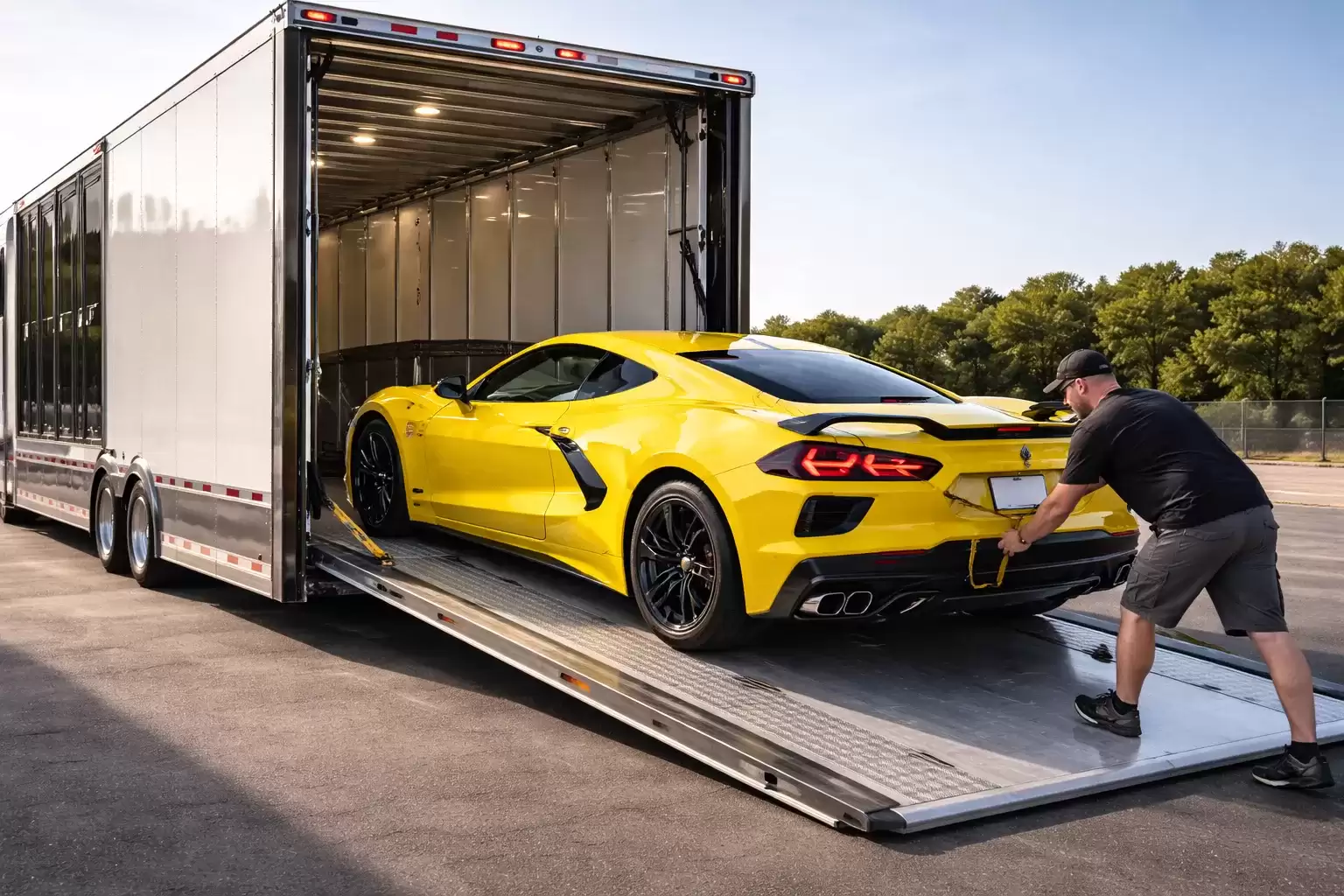
Yellow sports car being loaded into an enclosed auto transport trailer for Texas delivery

Ready to ship your car to or from Texas?

Join hundreds of thousands of customers — military families, tech relocators, Rio Grande Valley Snowbirds, students, and families moving across the country — who have trusted Direct Express Auto Transport with their Texas vehicle shipments since 2004. Get your instant, no-obligation quote now. It takes 30 seconds, requires no personal information, and there is no upfront payment required to hold your spot.

Instant quote — real-time pricing in under 5 seconds
No upfront payment — your card is charged only when a carrier is assigned
No risk to get a quote and book your order
BBB Accredited A+ since 2004
FMCSA licensed and fully bonded
4.6 stars across thousands of verified Google reviews