
North Carolina Car Shipping Services
Need to ship a car to or from North Carolina? Get a real-time, transparent price in 30 seconds — no phone calls, no risk, no upfront payment. Direct Express Auto Transport has been the Tar Heel State’s most trusted auto transport broker since 2004, with a 4.6-star average across thousands of verified Google reviews.
★ 4.6/5 Google Reviews | BBB Accredited A+ | FMCSA Licensed (MC #479342) | USDOT #1240502 | No upfront payment required | 20+ years shipping vehicles


North Carolina car shipping costs vary based on your route, the time of year, vehicle size, and service tier. Use our instant calculator above for a real-time quote — or see the route-by-route pricing tables below. Most standard sedan shipments to or from North Carolina range from $385 on short regional hauls to neighboring Virginia up to $1,530+ on long-haul routes to California. Charlotte’s I-85/I-77 position and the Research Triangle’s I-40 access give North Carolina two of the best-served carrier corridors in the Southeast — which keeps pricing competitive on most routes year-round. Our Expedited and Rush tiers accelerate pickup for shippers with firm schedules, including the many military families who need to meet a specific report date at Fort Liberty or Camp Lejeune.

What customers say about shipping a car to or from North Carolina with Direct Express Auto Transport


The interstate corridors that move North Carolina vehicles
Five primary highway arteries define North Carolina’s auto transport network:
I-85 (Northeast-Southwest spine): Enters North Carolina from Virginia near Norlina and runs southwest through Henderson, Durham, Hillsborough, Burlington, Greensboro, High Point, Lexington, Salisbury, Concord, and Charlotte before crossing into South Carolina. I-85 is North Carolina’s most important auto transport corridor — it connects the state to the Northeast (via I-85 north into Virginia and I-95) and to the Deep South (via I-85 south through Greenville, Spartanburg, and Atlanta). Every carrier running between the Northeast and Atlanta passes through North Carolina on I-85. The Charlotte metro, the Research Triangle via the I-85/I-40 junction, and the Piedmont Triad cities of Greensboro and Burlington all anchor this corridor.
I-95 (East Coast coastal corridor): Enters North Carolina from Virginia near Roanoke Rapids and runs south through Rocky Mount, Wilson, Fayetteville, and Lumberton before crossing into South Carolina near Dillon. I-95 is the primary carrier route for the East Coast Snowbird corridor and for military vehicles moving to and from Fort Liberty. The I-95 corridor through eastern North Carolina is one of the most carrier-active stretches of interstate on the East Coast — carriers moving between New York, Washington, and Florida pass through this corridor every day of the year.
I-40 (East-West spine): Begins at Wilmington on the coast and runs west through Raleigh, Durham, Burlington, Greensboro, Winston-Salem, Statesville, and Asheville before entering Tennessee at the Smoky Mountains. I-40 is the primary east-west auto transport artery in North Carolina, connecting coastal Wilmington to the Research Triangle, the Piedmont Triad, and ultimately to Tennessee and the western United States. Asheville, at the western end of I-40, sits at the I-26 junction and is the gateway to the mountain communities of western North Carolina.
I-77 (Charlotte north-south connector): Enters North Carolina from Virginia near Galax and runs south through Statesville and Charlotte before crossing into South Carolina near Fort Mill. I-77 is Charlotte’s primary north-south carrier route, connecting the Queen City to Columbia, South Carolina to the south and to the Virginia and Ohio markets to the north. Carriers on I-77 between Charlotte and the Midwest, and between Charlotte and the Deep South, make Charlotte one of the most carrier-available markets in the Carolinas.
I-26 (Asheville south connector): Connects Asheville south to Hendersonville, Spartanburg, and ultimately Columbia and Charleston, South Carolina. I-26 is Asheville’s primary carrier route to the south, giving the mountain city access to East Coast carrier traffic via the Spartanburg/I-85 interchange. Combined with I-40 east to the Piedmont and I-40 west into Tennessee, Asheville has better carrier access than most mountain communities of its size.
Vehicles shipping to or from Charlotte, the Research Triangle, or Greensboro/Winston-Salem benefit from the highest carrier frequency in the state. Eastern North Carolina along I-95 is well-served by Snowbird transit traffic. The Wilmington coast and the mountain communities west of Asheville have solid but somewhat slower carrier availability; Expedited tier is recommended for specific pickup dates in those markets. The Outer Banks barrier island communities require advance meet-point coordination regardless of tier — contact our team before booking any OBX shipment.


Shipping a car to or from the Outer Banks: what you need to know
The Outer Banks of North Carolina are among the most geographically distinctive auto transport markets in the country. The OBX communities — Corolla, Duck, Southern Shores, Kitty Hawk, Kill Devil Hills, Nags Head, Manteo, Rodanthe, Waves, Salvo, Avon, Buxton, Hatteras, and Ocracoke — are located on a chain of narrow barrier islands separated from the North Carolina mainland by Albemarle and Pamlico Sounds. Access to most of these communities is via two-lane highway bridges and, in the case of Ocracoke Island, ferry service only.
Why standard door-to-door service does not work on the OBX: Commercial carrier trucks running at federal gross vehicle weight limits cannot safely traverse many of the two-lane barrier island bridges and the narrow NC-12 corridor that connects OBX communities north to south. The weight limits on OBX bridges, the absence of turnaround space for a 75-foot carrier rig in most beach communities, and the single-road island topology make standard door-to-door pickup impossible for most OBX addresses.
The OBX meet-point protocol: All Outer Banks vehicle shipments are coordinated as meet-point pickups and deliveries. The standard meet-point is on the mainland side of the bridge approaches — typically in Manteo at the Roanoke Island approach, or in Point Harbor/Harbinger near the Wright Memorial Bridge approach for northern OBX communities. You drive your vehicle to the meet point, hand it to the carrier there, and it is loaded onto the trailer on the mainland side. Delivery works in reverse — you meet the carrier at the mainland-side meet point and drive from there to your island address.
OBX seasonal demand: The Outer Banks have an extreme seasonal demand curve. Summer (Memorial Day through Labor Day) is the peak season, when hundreds of thousands of vacationers and seasonal renters fill the island communities and vehicle transport demand spikes sharply. Expedited tier is strongly recommended for OBX summer shipments; book 10–14 days ahead. The off-season (October through April) has minimal carrier demand on the OBX, but the meet-point protocol still applies regardless of season. Contact our team directly before booking any Outer Banks shipment so we can set accurate expectations and confirm your specific meet-point location.
North Carolina’s major auto carrier hubs and what they mean for you
Charlotte Metro (Mecklenburg, Union, Cabarrus, Gaston, and surrounding counties): The dominant carrier hub for all of North Carolina and arguably for the entire Carolinas region. The I-85/I-77 interchange in Charlotte creates the highest carrier density in the state, with daily departures to New York, Atlanta, Florida, Texas, Ohio, Michigan, and every major market. Bank of America, Wells Fargo, Truist, and the financial services industry generate year-round corporate relocation demand that insulates Charlotte’s market from seasonal swings. The NASCAR motorsports corridor in Concord and Mooresville adds a unique dimension — racing teams, sponsors, and industry professionals ship vehicles on Charlotte-originating routes regularly. Suburban Charlotte communities — Concord, Kannapolis, Mooresville, Huntersville, Cornelius, Davidson, Gastonia, Belmont, and Ballantyne — are all served door-to-door on the same carrier circuits.
Research Triangle (Raleigh / Durham / Chapel Hill / Cary / Apex): North Carolina’s second-largest auto transport market, driven by the technology, pharmaceutical, and life sciences industries concentrated in and around Research Triangle Park. NC State’s 37,000-student enrollment and UNC-Chapel Hill’s 32,000 students add substantial education-sector car hauling demand to the professional relocation baseline. Raleigh is on I-40 at the I-440/I-540 beltway system; Durham is on I-85 and US-70. Carriers on I-40 between Wilmington and the Midwest, and carriers on I-85 between the Northeast and Atlanta, both pass through the Research Triangle corridor — giving the market carrier access from four directions.
Piedmont Triad (Greensboro / Winston-Salem / High Point): The central North Carolina market at the I-40/I-85 interchange in Greensboro and the I-40 corridor through Winston-Salem. Greensboro and Winston-Salem are positioned mid-state between Charlotte and the Research Triangle, served by carriers on both the I-85 and I-40 trunk routes. UNC Greensboro, NC A&T, Wake Forest University, and High Point University add education-sector vehicle shipping. The furniture manufacturing industry, historically centered in High Point, generates commercial logistics activity that contributes to the region’s carrier density.
Fayetteville / Fort Liberty: The military capital of North Carolina and one of the most PCS-active auto transport markets in the entire United States. Fort Liberty’s population of approximately 53,000 soldiers plus tens of thousands of family members makes Fayetteville one of the highest-volume military vehicle shipping markets in the country. PCS moves from Fort Liberty connect to Fort Cavazos and Fort Sam Houston in Texas, Fort Campbell in Kentucky, Joint Base Lewis-McChord in Washington, Fort Drum in New York, and installations in Georgia, Virginia, Hawaii, Alaska, and Europe. Expedited tier is strongly recommended for all Fort Liberty PCS moves with firm reporting dates.
Jacksonville / Camp Lejeune: North Carolina’s second major military hub, home to Camp Lejeune and Marine Corps Air Station Cherry Point (accessible via US-70 near New Bern). Camp Lejeune’s 2nd Marine Expeditionary Force — approximately 45,000 Marines and sailors — generates PCS move volume connecting Jacksonville to Camp Pendleton and Twentynine Palms in California, and installations across the country. Jacksonville is accessed via US-17 from I-40 near Wilmington or from the north via US-17 from the Virginia border. Expedited tier is recommended for all Camp Lejeune PCS shipments.
Asheville / Western North Carolina: The mountain retirement and second-home capital of the Southeast. Asheville sits at the I-26/I-40 junction and has better carrier access than most mountain cities its size — carriers on I-40 between the Research Triangle/Piedmont and Tennessee pass through, and I-26 connects south to Spartanburg and the I-85 corridor. Asheville’s growing reputation as a retirement and lifestyle destination draws significant inbound migration from the Northeast and Midwest. The surrounding mountain communities — Hendersonville, Brevard, Weaverville, Black Mountain, Burnsville, Boone, Banner Elk, and Blowing Rock — have slower carrier access due to their Blue Ridge Mountain locations; Expedited tier is recommended for these off-corridor addresses.
Wilmington / Cape Fear Coast: The eastern terminus of I-40 and North Carolina’s largest coastal city. Wilmington is a growing destination for retirees and remote workers from the Northeast, attracted by its historic downtown, Atlantic beach communities, and relatively affordable coastal real estate. The University of North Carolina Wilmington adds student car transport demand. Carriers on I-40 between the Research Triangle and the coast serve Wilmington regularly. The surrounding beach communities — Wrightsville Beach, Carolina Beach, Kure Beach, and Ocean Isle Beach — are accessible by carrier on the same circuits, though barrier island beach addresses occasionally require meet-point coordination.
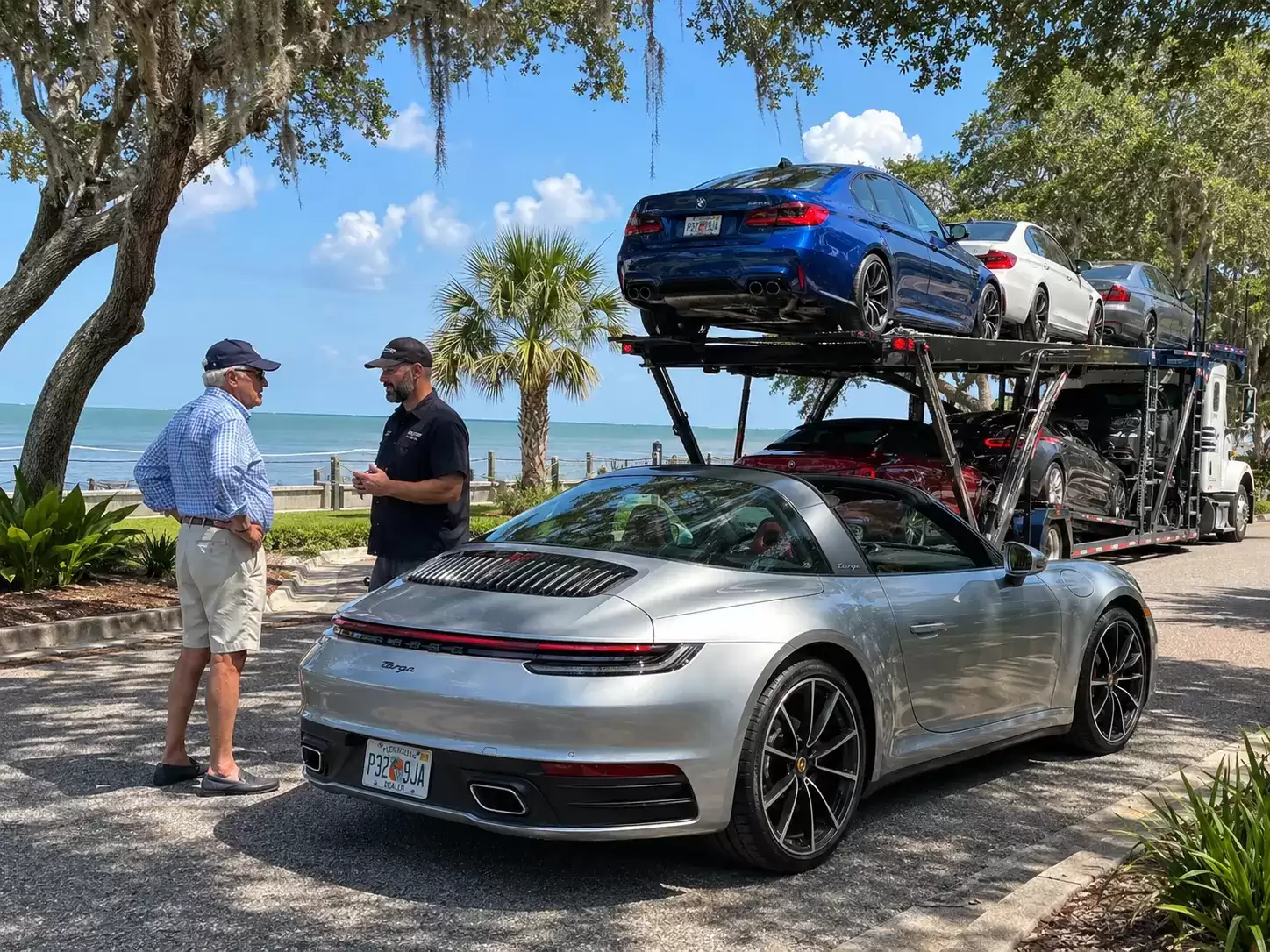
North Carolina car shipping cost estimates: major routes
The tables below show estimated pricing for the most commonly requested North Carolina auto transport routes, based on real-time market data for a standard operable sedan via open carrier. All prices reflect current market conditions for Standard, Expedited, and Rush tiers. Your actual quote may vary based on vehicle size, exact pickup/delivery zip codes, and seasonal demand. Use our instant calculator for a real-time rate.
Popular Routes To North Carolina
Swipe to view full table →
| From | To | Distance (mi) | Estimated Days | Standard | Expedited | Rush |
|---|---|---|---|---|---|---|
| New York | North Carolina | 650 | 2–4 days | $740 | $890 | $1,035 |
| Florida | North Carolina | 700 | 2–4 days | $755 | $905 | $1,055 |
| California | North Carolina | 2,700 | 7–9 days | $1,430 | $1,715 | $2,000 |
| Texas | North Carolina | 1,400 | 4–6 days | $980 | $1,175 | $1,370 |
| Georgia | North Carolina | 400 | 1–2 days | $570 | $685 | $800 |
| Michigan | North Carolina | 860 | 2–4 days | $815 | $980 | $1,140 |
| Illinois | North Carolina | 900 | 3–5 days | $830 | $995 | $1,160 |
| Ohio | North Carolina | 575 | 2–3 days | $695 | $835 | $975 |
| Colorado | North Carolina | 1,800 | 5–6 days | $1,170 | $1,405 | $1,640 |
| Virginia | North Carolina | 300 | 1–2 days | $485 | $580 | $680 |
Popular Routes From North Carolina
Swipe to view full table →
| From | To | Distance (mi) | Estimated Days | Standard | Expedited | Rush |
|---|---|---|---|---|---|---|
| North Carolina | Florida | 700 | 2–4 days | $755 | $905 | $1,055 |
| North Carolina | New York | 650 | 2–4 days | $740 | $890 | $1,035 |
| North Carolina | California | 2,700 | 7–9 days | $1,430 | $1,715 | $2,000 |
| North Carolina | Texas | 1,400 | 4–6 days | $980 | $1,175 | $1,370 |
| North Carolina | Georgia | 400 | 1–2 days | $570 | $685 | $800 |
| North Carolina | Michigan | 860 | 2–4 days | $815 | $980 | $1,140 |
| North Carolina | Illinois | 900 | 3–5 days | $830 | $995 | $1,160 |
| North Carolina | Ohio | 575 | 2–3 days | $695 | $835 | $975 |
| North Carolina | Arizona | 2,100 | 5–7 days | $1,280 | $1,535 | $1,790 |
| North Carolina | Virginia | 300 | 1–2 days | $485 | $580 | $680 |
Why long-haul North Carolina routes have a lower cost per mile: On a 2,700-mile California-to-North Carolina vehicle transport, carriers running a full transcontinental route optimize their trailer mix across the distance, bringing the per-mile rate down significantly. On a shorter 300-mile Virginia-to-North Carolina haul, fixed costs spread across fewer miles, so the per-mile rate is higher. This is why Charlotte to Richmond at $485 costs more per mile than Charlotte to Los Angeles at $1,430 — distance works in the shipper’s favor on long routes. The same principle explains why the New York–to–Charlotte corridor at $740 for 650 miles is priced more efficiently per mile than the Virginia–to–Charlotte run at $485 for 300 miles.

Best time to ship a car to or from North Carolina — the complete seasonal guide

Standard, Expedited, or Rush — which tier is right for your North Carolina vehicle transport?
Swipe to view full table →
| Tier | Best for NC when… | What to expect |
|---|---|---|
| Standard | Flexible schedule; Dec–Feb outbound window; any route with a 10+ day window; non-urgent civilian moves on the Charlotte or Research Triangle corridor | Assignment in 4–8 days on major corridors. Best value when you are not tied to a specific pickup date and can let the market work for you. |
| Expedited (most popular) |
Military PCS at Fort Liberty or Camp Lejeune; corporate relocations with firm start dates; OBX summer season; any time you want assignment certainty on Charlotte or Triangle routes | Assignment in 1–4 days. Strongly recommended Jun–Aug during PCS season and for any NC shipper with a fixed move date. |
| Rush | Last-minute PCS orders with a firm reporting date; emergency relocations; compressed executive moves; OBX summer with no other option | Priority dispatch, often assigned within 24–48 hours. Best for urgent moves when Standard and Expedited windows are too long. |
On most North Carolina routes, Expedited is the tier we recommend most often — not just during PCS season. North Carolina is an active auto transport market year-round anchored by Charlotte’s carrier density and the Research Triangle’s professional relocation volume. The Fort Liberty and Camp Lejeune military communities add consistent military PCS demand that keeps North Carolina’s carrier network busier than most Southeast states its size. Even in North Carolina’s quietest months, the step from Standard to Expedited is typically $75–$130 on a major corridor, and that premium meaningfully increases how quickly your load is matched to a car carrier over others waiting on the same route. Most repeat NC customers — military families, Charlotte corporate transferees, and Research Triangle professionals — default to Expedited after their first vehicle shipment.
Standard tier works well for: vehicle transport in December through February with a 10-day or longer flexible window, any route from Charlotte or the Research Triangle where carrier frequency is naturally high, and budget-conscious shippers with no fixed move date who can accommodate a variable pickup window.
Rush tier is the right call for: last-minute PCS orders at Fort Liberty or Camp Lejeune with a firm reporting date, emergency corporate relocations with hard start dates in the Charlotte financial corridor, Outer Banks summer shipments when no advance booking was made and you need the vehicle moved within days, and executive vehicle relocation with compressed timelines.


How North Carolina car shipping works: 4 simple steps
Step 1 — Get your instant quote. Use our online calculator to get a real-time North Carolina car shipping rate in 30 seconds. Enter your pickup zip code, delivery zip code, vehicle type, and preferred service tier. No phone call required. No upfront payment at this stage.
Step 2 — Book your shipment. Confirm your order online. We post your load to our network of vetted, FMCSA-licensed carriers. For military PCS moves at Fort Liberty or Camp Lejeune, our team contacts you directly to confirm your report date and schedule accordingly. For Outer Banks addresses, we confirm your mainland meet-point location before dispatch. You pay nothing until a carrier is assigned.
Step 3 — Pickup and inspection. Your assigned car carrier contacts you 12–24 hours before pickup to confirm the appointment. At pickup, both you and the driver complete a detailed vehicle inspection on the Bill of Lading, documenting every existing mark, scratch, or dent. You receive a copy before the truck leaves your location.
Step 4 — Delivery and final inspection. Your vehicle is delivered to your destination address or designated meet point. Complete a second inspection against the original Bill of Lading before signing off. Payment is due at delivery — typically by cash or certified funds to the carrier directly.
North Carolina university auto transport: moving students’ vehicles
North Carolina hosts one of the most distinguished university systems in the South — and one of the largest by combined enrollment. The UNC System’s 17 campuses enroll over 240,000 students, anchored by UNC-Chapel Hill, NC State, and UNC Charlotte. The state’s private universities — Duke, Wake Forest, Elon, Davidson, and High Point — draw students from across the country. Student vehicle shipping peaks in late August and early January, with a secondary move-out peak in May.
Swipe to view full table →
| University | Location | Enrollment | Nearest Major Carrier Corridor |
|---|---|---|---|
| NC State University | Raleigh | ~37,000 | I-40 / I-440 Research Triangle |
| UNC Charlotte | Charlotte | ~30,000 | I-85 / I-77 Charlotte Metro |
| UNC Chapel Hill | Chapel Hill | ~32,000 | I-40 / US-15-501 Research Triangle |
| East Carolina University | Greenville | ~29,000 | US-264 / Eastern NC |
| Appalachian State University | Boone | ~21,000 | US-421 / Blue Ridge High Country |
| Duke University | Durham | ~17,000 | I-85 / US-70 Research Triangle |
| UNC Greensboro | Greensboro | ~20,000 | I-40 / I-85 Piedmont Triad |
| NC A&T State University | Greensboro | ~13,000 | I-40 / I-85 Piedmont Triad |
| Western Carolina University | Cullowhee | ~12,000 | US-23 / I-40 Western Mountains |
| Wake Forest University | Winston-Salem | ~9,000 | I-40 Piedmont Triad |
Tips for North Carolina university vehicle transport: Book 2 to 3 weeks ahead of fall move-in dates at NC State and UNC-Chapel Hill, as carrier availability tightens in late August across the entire state. Door-to-door delivery is available to most campus areas. Duke University’s Durham campus and UNC-Chapel Hill’s campus areas are carrier-accessible, though dense residential streets near campus may occasionally require a nearby meet point. Appalachian State in Boone and Western Carolina in Cullowhee are off the primary carrier trunk routes; Expedited tier is recommended for those addresses during August and May peak periods.

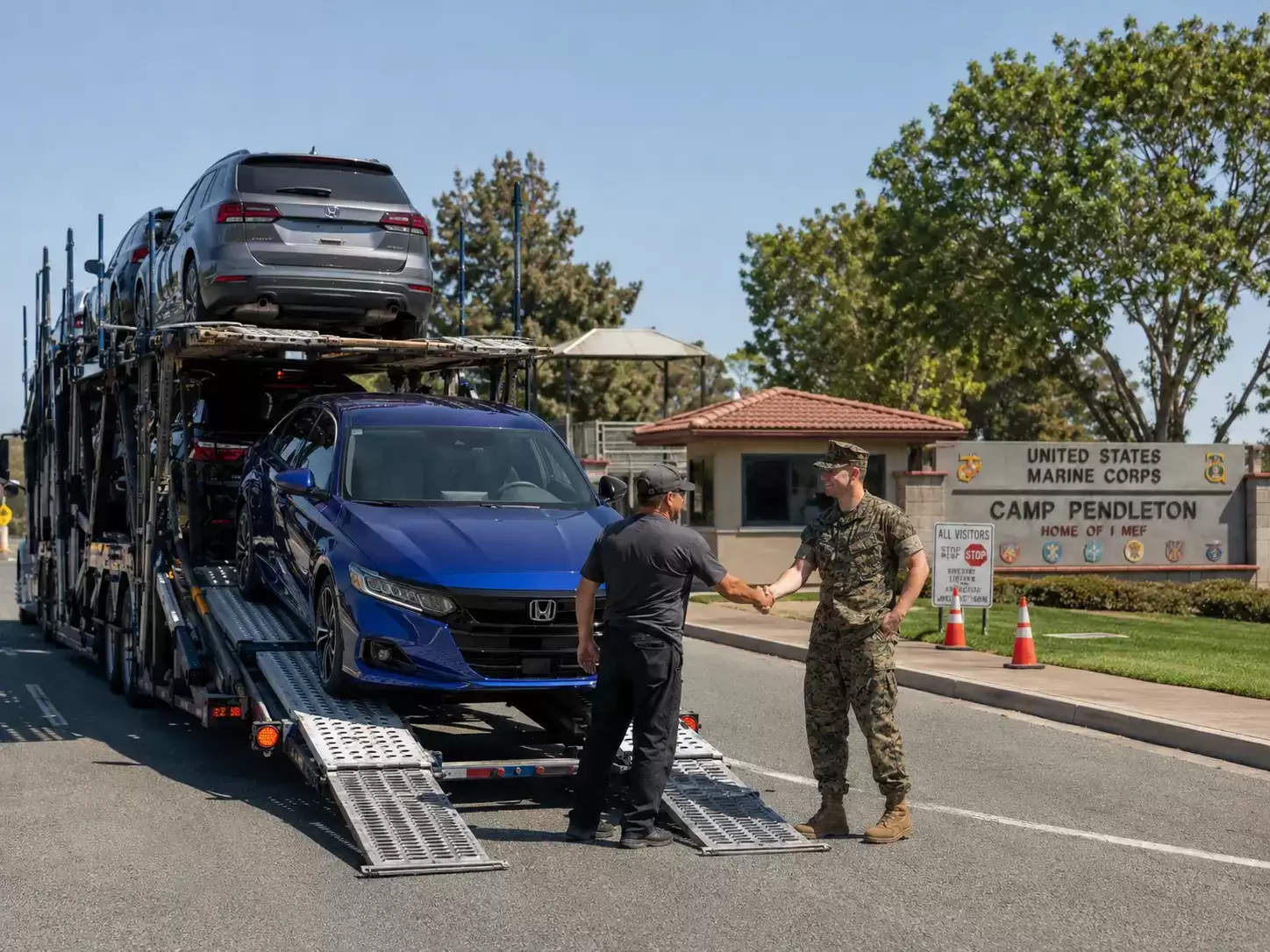
Military Vehicle Shipping to and From North Carolina Bases
North Carolina hosts more military personnel than almost any other state in the country. Fort Liberty alone — the world’s largest military installation by population — generates PCS move volume that would rank North Carolina among the top military auto transport states even without the addition of Camp Lejeune, MCAS Cherry Point, Seymour Johnson AFB, Pope Army Airfield, and Coast Guard Air Station Elizabeth City. Military PCS season (June through August) is the single highest-demand period of the year in North Carolina, and Expedited tier is strongly recommended for all military shipments with firm report dates.
Fort Liberty (formerly Fort Bragg) — Fayetteville
The U.S. Army’s largest installation and the world’s most populous military base, home to approximately 53,000 soldiers plus tens of thousands of family members. Fort Liberty hosts the 82nd Airborne Division, the 18th Airborne Corps, U.S. Army Special Operations Command, and multiple other major commands. PCS moves from Fort Liberty connect to virtually every major installation in the country: Fort Cavazos and Fort Sam Houston in Texas, Fort Campbell in Kentucky, Joint Base Lewis-McChord in Washington, Fort Drum in New York, Fort Wainwright in Alaska, and overseas gateways in Germany, Italy, Korea, and Japan. The installation is accessible via I-95 to US-401. Expedited tier is strongly recommended for all Fort Liberty PCS shipments; book 2–3 weeks ahead during the June–August PCS peak.
Camp Lejeune — Jacksonville
The Marine Corps’ premier East Coast training and deployment base, home to the 2nd Marine Expeditionary Force with approximately 45,000 Marines and sailors. Camp Lejeune PCS moves commonly route to Camp Pendleton and Twentynine Palms in California, Camp Foster in Okinawa (as a CONUS gateway), Camp Schwab and other Pacific installations, and East Coast bases including Quantico, Cherry Point, and Camp Geiger. Jacksonville is accessed via US-17 from I-40 near Wilmington or via US-17 south from the Virginia border — neither is a primary carrier trunk route. Expedited tier is recommended for all Camp Lejeune vehicle shipments with firm reporting dates, and direct coordination with our team on your orders is advised for cross-country moves.
MCAS Cherry Point — Havelock (near New Bern)
Home to the 2nd Marine Aircraft Wing, Marine Corps Air Station Cherry Point is the largest Marine Corps air station on the East Coast. Located in Havelock on US-70 near New Bern in coastal eastern North Carolina, Cherry Point generates steady PCS vehicle transport connecting the base to Marine aviation installations at Beaufort, South Carolina, Miramar in California, Iwakuni in Japan, and other Marine Corps air stations. US-70 connects Cherry Point toward the Research Triangle and the broader carrier network; Expedited tier is recommended for Cherry Point shipments with firm dates.
Seymour Johnson AFB — Goldsboro
Home to the 4th Fighter Wing flying the F-15E Strike Eagle, Seymour Johnson AFB is located in Goldsboro on US-70 and I-795 in eastern North Carolina. The base generates PCS vehicle transport connecting Goldsboro to Air Force installations at Langley in Virginia, Mountain Home in Idaho, Elmendorf in Alaska, Lakenheath in the UK, and other F-15 and strike aircraft bases. Goldsboro is accessible from the I-95 corridor via US-70, which also connects west toward Raleigh and the Research Triangle network. Expedited tier is recommended for Seymour Johnson PCS moves with firm reporting dates.
Pope Army Airfield — Fayetteville (adjacent to Fort Liberty)
The strategic airlift hub co-located with Fort Liberty, Pope Army Airfield provides primary airlift support for the 82nd Airborne Division’s global rapid deployment mission. Pope generates additional auto transport volume beyond Fort Liberty’s primary population, particularly for Air Force and joint service personnel assigned to the airfield’s support mission. Vehicle shipments from Pope use the same I-95/US-401 access routes as Fort Liberty; Expedited tier applies equally here for any PCS move with a firm report date.
Coast Guard Air Station Elizabeth City — Elizabeth City
The largest Coast Guard air station in the world by facility size, located in Elizabeth City in northeastern North Carolina near the Virginia border. CGAS Elizabeth City is the Coast Guard’s primary aircraft maintenance and logistics facility, housing the Aviation Technical Training Center and supporting search-and-rescue operations along the entire East Coast. The station generates PCS vehicle transport connecting Elizabeth City to Coast Guard bases in Clearwater, Florida; Kodiak, Alaska; Astoria, Oregon; and other aviation stations. Elizabeth City is accessible via US-17 and US-158; Expedited tier is recommended for firm-date PCS moves from this location.
A note for military members: Always verify whether your branch covers POV (Privately Owned Vehicle) shipment costs under your PCS orders before booking. If your move qualifies, government shipping may be arranged through your transportation office, but many service members choose a private carrier for speed, flexibility, or to ship a second vehicle not covered by orders. Our team handles North Carolina military vehicle shipping regularly and understands the timing requirements that come with PCS calendars.
North Carolina cities we serve
Direct Express Auto Transport provides vehicle shipping services to and from every city and community in North Carolina. Our highest-volume North Carolina markets include:
Charlotte — The Southeast’s second banking capital and North Carolina’s dominant auto transport hub at the I-85/I-77 interchange. Bank of America’s global headquarters and Wells Fargo’s major East Coast operations anchor a financial sector that generates enormous professional relocation demand year-round. The NASCAR motorsports corridor in Concord and Mooresville adds a uniquely Charlotte dimension. Daily carrier departures from Charlotte reach Florida, New York, California, Texas, and every major U.S. market. Standard tier pickup windows in the Charlotte metro are shorter than the Southeast average.
Raleigh / Research Triangle — NC’s tech and pharma hub anchored by NC State University and Research Triangle Park. IBM, Cisco, Red Hat, SAS Institute, Biogen, GlaxoSmithKline, and Lenovo U.S. headquarters generate consistent inbound vehicle transport from California, New York, and Boston. I-40 and the I-440/I-540 beltway give Raleigh carrier access in every direction. The city is one of the fastest-growing auto shipping markets in the Southeast, driven entirely by professional relocation rather than any single seasonal event.
Durham / Chapel Hill — Duke University and UNC-Chapel Hill anchor a highly educated professional community with strong auto transport ties to Boston, New York, and California. Durham is on I-85 and US-70; Chapel Hill is on I-40 via US-15-501. Duke’s medical center and UNC’s hospital system generate healthcare professional relocations in addition to the academic and pharmaceutical demand from Research Triangle Park. Both markets are fully accessible door-to-door on daily carrier circuits.
Greensboro — Piedmont Triad hub at the I-40/I-85 interchange in the geographic center of North Carolina. UNC Greensboro and NC A&T State University collectively enroll over 33,000 students. The city’s position equidistant between Charlotte and the Research Triangle gives it carrier access from both the I-85 trunk and the I-40 corridor simultaneously. Greensboro is one of the most consistently well-served mid-market cities in North Carolina for vehicle hauling.
Winston-Salem — Western Piedmont Triad city on I-40 with a growing innovation and healthcare economy anchored by Atrium Health Wake Forest Baptist. Wake Forest University adds academic relocation demand. Winston-Salem’s I-40 position gives it daily carrier access to the Research Triangle to the east and to Asheville and Tennessee to the west. The city’s vehicle shipping market reflects the Triad’s overall stability — steady demand with no extreme seasonal swings.
Fayetteville / Fort Liberty — Military capital of North Carolina and one of the most PCS-active auto transport markets in the United States. Fort Liberty’s 53,000-soldier population plus family members makes Fayetteville a vehicle shipping market that competes with cities three times its civilian size. PCS auto shipping connects Fayetteville to installations across all 50 states and overseas. Expedited tier is always recommended for Fort Liberty PCS moves with firm reporting dates.
Jacksonville / Camp Lejeune — Marine Corps hub in coastal eastern North Carolina, home to Camp Lejeune’s 45,000 Marines and sailors. Vehicle transport from Jacksonville connects to Marine bases from Camp Pendleton and Twentynine Palms in California to Okinawa gateways. Jacksonville is accessed via US-17; it sits off the primary carrier trunk routes, making Expedited tier the standard recommendation for all PCS moves with fixed report dates.
Asheville — Mountain retirement capital of the Southeast at the I-26/I-40 junction. Asheville draws steady inbound vehicle relocation from the Northeast and Midwest — retirees, remote workers, and lifestyle relocators drawn to its arts scene, outdoor recreation, mild summers, and craft food culture. Carriers on I-40 between the Piedmont and Tennessee pass through regularly. The surrounding mountain communities are accessible but slower; Expedited tier is recommended for off-corridor addresses in Hendersonville, Brevard, and the High Country.
Wilmington — Cape Fear coast and the eastern terminus of I-40. A growing destination for retirees and remote workers from the Northeast attracted by the historic Riverwalk district, Atlantic beach proximity, and comparatively affordable coastal real estate. UNC Wilmington’s 18,000 students add academic shipping. The surrounding beach communities (Wrightsville Beach, Carolina Beach, Kure Beach) are carrier-accessible door-to-door on most routes.
Cary / Apex / Morrisville — Research Triangle suburbs and among the fastest-growing communities in the United States. Cary, Apex, and Morrisville draw technology and pharmaceutical professionals from California, New York, and New Jersey relocating for Research Triangle Park positions. All three communities are fully accessible on the same carrier circuits as Raleigh and Durham, with door-to-door service on daily I-40 corridor runs.
Concord / Kannapolis / Mooresville — Charlotte metro NASCAR corridor northeast of the city on I-85 and I-77. Most NASCAR Cup Series teams maintain their race shops and headquarters in this corridor, generating a unique auto transport dimension uncommon in most markets. Racing industry professionals, sponsors, and equipment-related vehicle shipments make this corridor consistently active beyond its residential population. All three communities are served on the Charlotte carrier circuit with door-to-door access.
High Point / Burlington — Furniture capital and Piedmont manufacturing corridor in the I-40/I-85 zone between Greensboro and Durham. High Point’s twice-annual International Home Furnishings Market (April and October) brings an influx of industry professionals and vehicles from across the country. Burlington on I-40/I-85 is well-positioned between the Triad and the Triangle. Both markets are served on combined Greensboro-corridor carrier dispatches.
New Bern / Havelock / MCAS Cherry Point — Coastal eastern North Carolina on US-70. New Bern is one of the oldest cities in North Carolina with a growing retirement and second-home market. Havelock is the gateway to Marine Corps Air Station Cherry Point, generating military PCS vehicle transport demand. The US-70 corridor connects this eastern market toward Goldsboro and ultimately the Research Triangle. Expedited tier is recommended for PCS moves from Cherry Point with firm dates.
Outer Banks communities (Kitty Hawk, Kill Devil Hills, Nags Head, Manteo) — North Carolina’s iconic barrier island communities along NC-12 from Corolla south to Ocracoke. All OBX vehicle shipments require meet-point coordination on the mainland side of the bridge approaches. Standard door-to-door service is not available on the barrier islands due to bridge weight limits and the narrow single-road island corridor. Contact our team before booking any OBX shipment — we will confirm your meet-point location and set accurate timeline expectations based on your specific community and the time of year.
North Carolina vehicle registration and DMV resources
If you are moving to North Carolina, you are required to register your vehicle and obtain a North Carolina driver’s license within 60 days of establishing residency. The North Carolina Division of Motor Vehicles manages all vehicle registrations, title transfers, and license issuance.
- NC Division of Motor Vehicles — North Carolina’s primary DMV portal for vehicle registration, title transfers, license plates, and driver’s license services. New residents must establish NC registration within 60 days of moving to the state.
- NC Vehicle Title & Registration — Covers title transfer requirements for vehicles brought into North Carolina, including fee schedules, required documentation, and county DMV office locations statewide.
- NC Driver’s License for New Residents — Instructions for obtaining a North Carolina driver’s license as a new resident. Required within 60 days of establishing NC residency, concurrent with vehicle registration.
- NC Department of Revenue — Highway Use Tax — North Carolina charges a Highway Use Tax (HUT) in lieu of traditional sales tax when titling a vehicle. New residents should review HUT requirements before completing their title transfer.
- FMCSA SAFER — Verify a Carrier’s License — The Federal Motor Carrier Safety Administration’s carrier lookup tool. Verify that any auto transport company or car hauling broker you consider is federally licensed and insured before booking. Direct Express Auto Transport is FMCSA Licensed (MC #479342).

Popular long-distance North Carolina car shipping routes
North Carolina to Florida Car Shipping
North Carolina’s most active long-distance corridor. Retirees relocating from Charlotte, Raleigh, and the Piedmont Triad to Florida’s Gulf and Atlantic coasts make this one of the Southeast’s most consistent retirement migration vehicle shipping routes. Charlotte residents heading to Sarasota, Naples, Fort Myers, and the Tampa Bay area route via I-77 south to I-26 to I-95, or I-85 south to I-75. At approximately 700 miles from Charlotte to Tampa, transit runs 2–4 days. The fall southbound surge (September through November) is the highest-demand period; book Expedited for firm dates during those months.
North Carolina to New York Car Shipping
The reverse of the dominant inbound migration corridor. Professionals relocating from Charlotte and Raleigh to New York for finance and media roles, students heading home from North Carolina universities, and military families at Fort Liberty rotating to northeastern installations all use this route. I-85 north to I-95 north is the primary carrier artery. At 650 miles, transit runs 2–4 days. This is one of the most carrier-active corridors in the country, driven by the enormous two-way professional migration between the Northeast and North Carolina.
North Carolina to California Auto Transport
Research Triangle pharmaceutical and technology professionals relocating to the Bay Area or Los Angeles, and the reverse migration of California residents drawn to North Carolina’s lower cost of living, make this a growing bidirectional corridor. At 2,700 miles, carriers route through I-40 west through Tennessee and on across the country. Transit: 7–9 days. Expedited tier is strongly recommended for any California–North Carolina vehicle transport with a fixed relocation date.
North Carolina to Texas Vehicle Transport
Charlotte financial services professionals relocating to Dallas and Houston, Fort Liberty PCS moves to Fort Cavazos and Fort Sam Houston, and the broader Sunbelt-to-Sunbelt migration corridor keep North Carolina–Texas well-served. Carriers on I-85 to I-20 west through Alabama and Mississippi connect to the Texas market. Transit: 4–6 days. Both directions see consistent activity year-round on this corridor.
North Carolina to Georgia Car Shipping
One of North Carolina’s most active short-haul corridors. I-85 south from Charlotte to Atlanta runs approximately 4 hours, and carrier frequency reflects that proximity — departures in both directions daily. Charlotte and Atlanta are increasingly integrated as Southeast financial capitals, and the professional rotation between the two cities keeps this route exceptionally active. Transit: 1–2 days. This is one of the most affordable vehicle transport routes from Charlotte given the high carrier frequency in both directions.
North Carolina to Michigan Auto Shipping
Military PCS moves connect Fort Liberty and Camp Lejeune to Michigan’s military facilities. Professional relocations between the Research Triangle and the Detroit automotive corridor use this route regularly. I-77 north through Virginia and Ohio is the primary carrier routing. At approximately 860 miles, transit runs 2–4 days. Carriers on the I-77 Charlotte-to-Cleveland corridor serve this route on virtually every northbound run.
North Carolina to Ohio Vehicle Shipping
A solid regional route connecting North Carolina to Columbus, Cleveland, and Cincinnati. Carriers on I-77 north from Charlotte reach Ohio in a single driving day, and the route is well-served by carriers running the mid-Atlantic and Great Lakes corridor. At approximately 575 miles, transit runs 2–3 days. Ohio is a major origin state for military families rotating through Fort Liberty, making this a two-way route with consistent carrier availability in both directions.
North Carolina to Illinois Car Shipping
Charlotte and Chicago are closely connected by financial and professional ties. Carriers on I-85 north to I-81 north to I-70 west serve this route through the Mid-Atlantic and Midwest at approximately 900 miles. Transit: 3–5 days. The route is consistently well-served by carriers running the Southeast-to-Midwest corridor that passes through Virginia and Ohio.
North Carolina to Arizona Car Shipping
Phoenix and Scottsdale attract North Carolina retirees seeking a drier desert climate as an alternative to Florida. The long southern route runs I-85 to I-20 to I-10 west into Arizona at approximately 2,100 miles. Transit: 5–7 days. Expedited tier is recommended for moves during the fall Snowbird season when carrier space on western auto shipping routes tightens.
North Carolina to Virginia Auto Transport
North Carolina’s most active short-haul route. The I-85 and I-95 corridors connecting North Carolina to the Northern Virginia/DC metro and to Virginia’s military installations (Quantico, Fort Belvoir, Naval Station Norfolk, Langley AFB) are extremely carrier-dense. Military PCS moves between Fort Liberty and Virginia installations are a major segment of this corridor. At approximately 300 miles, transit runs 1–2 days.
North Carolina to Washington State Car Shipping
Military PCS orders connecting Fort Liberty and Camp Lejeune to Joint Base Lewis-McChord in Tacoma are one of the most common cross-country military auto transport routes in the country. At approximately 2,900 miles, the route runs I-40 west through Tennessee or I-81 north and across the northern route through Montana and Idaho to I-90. Transit: 7–10 days. Expedited tier is strongly recommended for all JBLM-bound shipments with firm report dates.
North Carolina to Colorado Car Transport
Mountain West migration from Charlotte and the Research Triangle, plus military PCS moves from Fort Liberty to Colorado installations (Fort Carson, Peterson SFB, Schriever SFB), keep this corridor active. At approximately 1,800 miles, the route runs west through Tennessee and across I-70. Transit: 5–6 days. The corridor sees a fall peak as moves wrap up before ski season begins in the Colorado high country.

Nearby states for North Carolina auto transport
Virginia
North Carolina’s northern neighbor on I-85, I-95, I-77, and I-81. The military corridor connecting North Carolina’s installations to Virginia’s massive defense complex — Naval Station Norfolk, Quantico, Fort Belvoir, Langley AFB, and the Pentagon — is one of the most active PCS vehicle shipping corridors in the country. The Charlotte–Northern Virginia professional relocation market adds a strong corporate dimension. Transit: 1–2 days.
South Carolina
North Carolina’s southern neighbor. Charlotte sits on the North Carolina–South Carolina border; Fort Mill and Rock Hill, SC are effectively Charlotte suburbs. The I-85 corridor south through Greenville and Spartanburg connects the Charlotte metro directly to Upstate South Carolina and ultimately to Atlanta. The coastal retirement market of Myrtle Beach draws North Carolinians regularly. Transit: 1 day.
Tennessee
Western North Carolina’s neighboring state via I-40 through the Smoky Mountains and I-26 through Asheville. Asheville and Knoxville are closely connected markets; Nashville and Memphis draw professionals and retirees from the Piedmont Triad and Charlotte. The mountain border communities share carrier circuits. Transit: 1–2 days.
Georgia
North Carolina’s southwest neighbor via I-85. Charlotte to Atlanta is one of the most carrier-active interstate segments in the Southeast, with car carrier departures in both directions multiple times daily. The NC–GA corridor is driven equally by corporate relocation traffic and by the general migration of professionals between the two fastest-growing Southeastern metros. Transit: 1–2 days.
West Virginia
North Carolina’s northwestern neighbor via US-221 and US-19 through the Blue Ridge and Appalachian mountain communities. The border region between northwestern North Carolina and West Virginia is rural and off the primary carrier routes. Carrier frequency is lower; Expedited tier is recommended for communities in this corridor. Transit: 1–2 days.

Auto transport in Metro Charlotte (I-85 / I-77 / I-485)
Charlotte is North Carolina’s dominant auto transport hub and one of the fastest-growing major cities in the United States. The I-85/I-77 interchange gives Charlotte carrier access from four directions — northeast to the Research Triangle and the Northeast, southwest to Atlanta and the Deep South, north to Virginia and Ohio, and south to South Carolina. Bank of America’s global headquarters and Wells Fargo’s major East Coast operations anchor a financial services industry that generates enormous professional relocation demand year-round. The NASCAR corridor in Concord and Mooresville — where most NASCAR Cup Series teams maintain their shops and headquarters — adds a uniquely Charlotte dimension to the vehicle transport market. The entire Charlotte metro — including Huntersville, Cornelius, Davidson, Kannapolis, Concord, Gastonia, Belmont, Matthews, Mint Hill, Pineville, Ballantyne, and Steele Creek — is served door-to-door on daily carrier circuits.
Auto transport in the Research Triangle (I-40 / I-85 / RTP)
The Research Triangle — encompassing Raleigh, Durham, Chapel Hill, Cary, Apex, Morrisville, Holly Springs, and Research Triangle Park itself — is North Carolina’s second auto transport hub and one of the most professionally diverse markets in the Southeast. NC State, UNC-Chapel Hill, and Duke University provide a deep pool of graduate and professional relocation demand. The technology and pharmaceutical companies at RTP — IBM, Cisco, Red Hat, Biogen, GlaxoSmithKline, Lenovo U.S. HQ — generate corporate relocation volume connecting the Triangle to Silicon Valley, Boston, New York, and New Jersey. I-40 provides east-west carrier access (Wilmington to Tennessee); I-85 provides northeast-southwest access (the Northeast to Atlanta). The Triangle benefits from daily carrier departures in every direction.
Auto transport in the Piedmont Triad (I-40 / Greensboro / Winston-Salem)
The Piedmont Triad — Greensboro, Winston-Salem, and High Point — sits at the I-40/I-85 interchange in the geographic center of the state, equidistant between Charlotte and the Research Triangle. Greensboro’s I-40/I-85 interchange is one of the most important carrier junction points in North Carolina — carriers on both arteries pass through, giving the Triad daily access to markets in every direction. UNC Greensboro, NC A&T, Wake Forest, and High Point University collectively enroll more than 50,000 students. The furniture industry historically centered in High Point contributes to the regional logistics infrastructure. Winston-Salem’s healthcare and innovation sector adds professional vehicle relocation demand.
Auto transport in Fayetteville and the Fort Liberty corridor (I-95 / US-401)
Fayetteville is North Carolina’s military capital and one of the most PCS-active auto transport markets in the United States. Fort Liberty’s 53,000-soldier population plus tens of thousands of family members create a vehicle shipping demand that makes Fayetteville competitive with markets twice its civilian size. I-95 is the primary highway serving the Fayetteville area, with US-401 connecting the base to the interstate. Carriers on I-95 between the Northeast and Florida pass near Fayetteville regularly, which keeps carrier availability solid for PCS moves on the East Coast corridor. For PCS moves to western installations (Texas, Washington, Colorado), Expedited tier is essential and direct coordination with our team on your report date is recommended.
Auto transport in Wilmington and the Cape Fear Coast (I-40 east)
Wilmington anchors the eastern end of I-40 and is North Carolina’s largest coastal city. UNC Wilmington’s 18,000 students, a growing retiree and remote-worker relocation market, and the area’s beach communities (Wrightsville Beach, Carolina Beach, Kure Beach) generate steady shipping demand. Carriers on I-40 between the Research Triangle and the coast serve Wilmington regularly. The surrounding beach communities are generally accessible but may require meet-point coordination for barrier island addresses. Brunswick County communities (Shallotte, Sunset Beach, Ocean Isle Beach) to the south are accessible via US-17.
Auto transport in Asheville and Western North Carolina (I-26 / I-40)
Asheville sits at the I-26/I-40 junction in the Blue Ridge Mountains, making it better-connected by interstate than most mountain cities its size. Carriers on I-40 between the Piedmont and Tennessee pass through, and I-26 connects south to Spartanburg and the I-85 corridor. Asheville’s national reputation as a retirement and lifestyle destination — arts scene, outdoor recreation, mild summers, craft food and beverage culture — draws a steady inbound relocation stream from the Northeast and Midwest. The surrounding mountain communities (Hendersonville, Brevard, Weaverville, Black Mountain, Burnsville) are accessible but off-corridor; Expedited tier is recommended. The High Country communities further north — Boone, Banner Elk, Blowing Rock — are accessed via US-421 and US-321; carrier frequency is lower here and Standard pickup windows run longer.
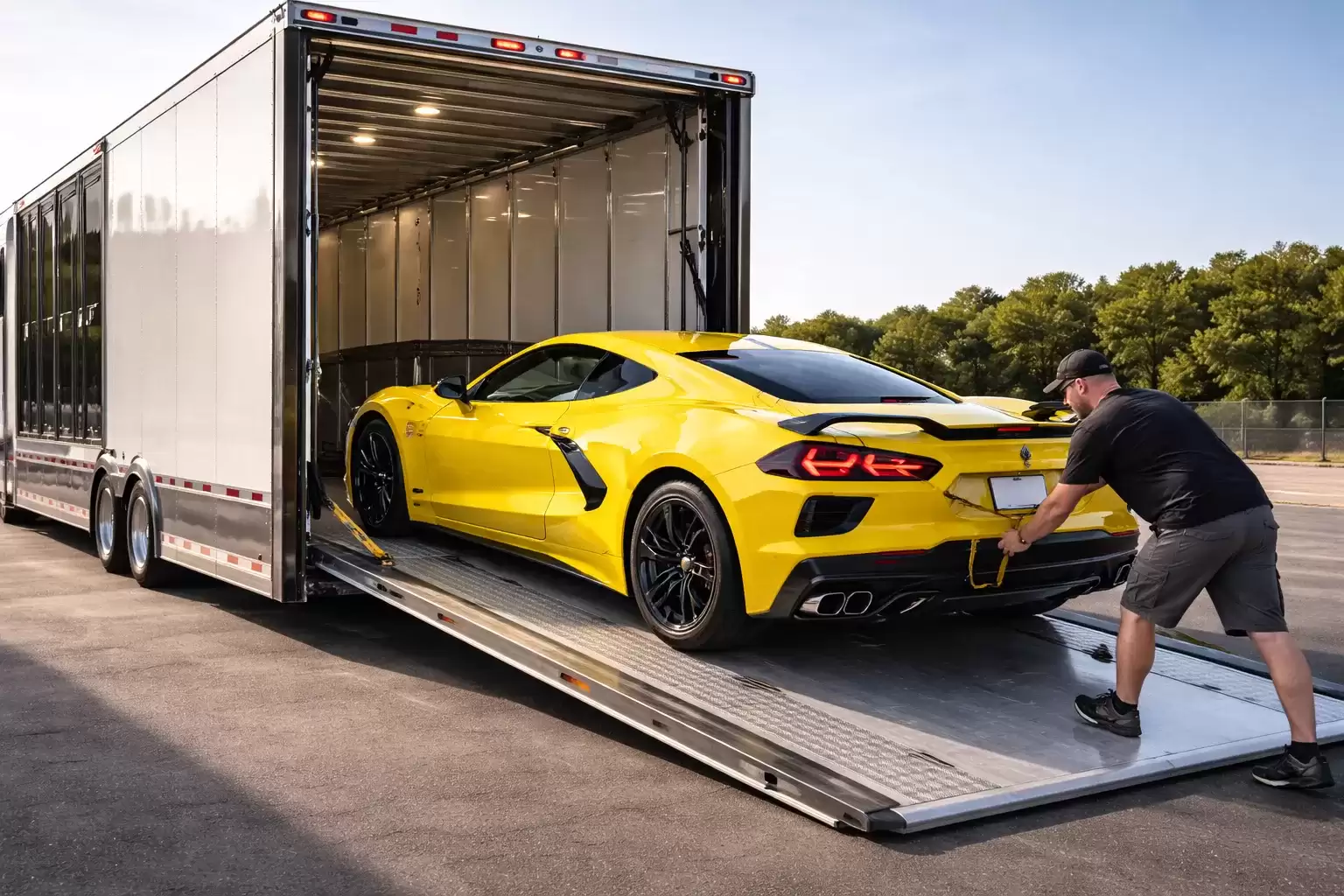
Ready to ship your car to or from North Carolina?
Get your instant North Carolina car shipping quote right now — no phone call required, no upfront payment, no obligation. Direct Express Auto Transport has been moving vehicles to and from North Carolina since 2004. Our team knows the Charlotte financial corridor, the Research Triangle tech campus logistics, the Fort Liberty and Camp Lejeune PCS process, the Outer Banks meet-point protocol, and the Asheville mountain community access requirements better than any broker in the business. Whether you’re a Northeast professional relocating to Charlotte or Raleigh, a military family at Fort Liberty or Camp Lejeune, a retiree heading to Asheville or the coast, or a student at Duke, UNC, or NC State — we have the carrier network and the experience to move your vehicle safely and on schedule.
Use our online calculator above for a real-time rate. Questions? Our customer service team is available seven days a week and is happy to walk you through the process for your specific North Carolina pickup location.